ENGAA 2016 D564/11
54 questions54 marks80Updated August 2025
The ENGAA 2016 D564/11 paper in full: all 54 questions, each with its answer. ENGAA is the Engineering Admissions Assessment. Sit it cold under exam timing, mark it, then work back through anything you missed using the solutions below.
Download the original PDF →Questions and answers are free. Full step-by-step worked solutions unlock with a free account. Start practising.
Question 1
1 markFind the complete set of solutions to .
- A.
- B.
- C.
- D.
- E.
- F.
- G.
- H.
Answer: G
Question 2
1 markA nuclide changes by radioactive decay into the nuclide . Which combination of emissions produces this change?
- A.3 alpha
- B.2 alpha and 1 beta
- C.2 alpha and 2 beta
- D.1 alpha and 2 beta
- E.3 beta
Answer: D
Question 3
1 markWhich one of the following is a simplification of ?
- A.
- B.
- C.
- D.1
- E.
- F.
- G.
- H.5
Answer: B
Question 4
1 markThe graph shown of quantity against quantity represents the motion of a body.
(A diagram shows a straight line graph passing through the origin (0,0) and the point (2.0, 10)).
(The scales on both axes are in the appropriate S.I. units, and the gravitational field strength is .)
Which two of the following could the graph represent?
1 kinetic energy against velocity for an object of mass 10 kg undergoing free-fall
2 potential energy against height for an object of mass 20 kg being lifted by a constant external force
3 velocity against time for an object of mass 20 kg being accelerated by a resultant force of 100 N
4 work done by an external force of 5N against distance moved for an object of mass 12 kg being moved at constant speed by (and in the direction of) the external force
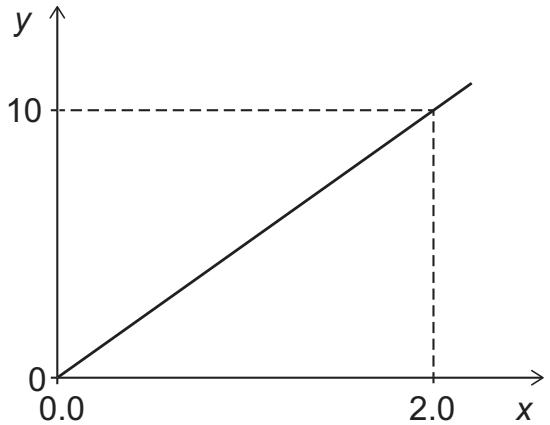
(A diagram shows a straight line graph passing through the origin (0,0) and the point (2.0, 10)).
(The scales on both axes are in the appropriate S.I. units, and the gravitational field strength is .)
Which two of the following could the graph represent?
1 kinetic energy against velocity for an object of mass 10 kg undergoing free-fall
2 potential energy against height for an object of mass 20 kg being lifted by a constant external force
3 velocity against time for an object of mass 20 kg being accelerated by a resultant force of 100 N
4 work done by an external force of 5N against distance moved for an object of mass 12 kg being moved at constant speed by (and in the direction of) the external force
- A.1 and 2
- B.1 and 3
- C.1 and 4
- D.2 and 3
- E.2 and 4
- F.3 and 4
Answer: F
Question 5
1 markThe ratio of Q:R is 5:2 and the ratio of R:S is 3:10
Which one of the following gives the ratio Q:S in its simplest form?
Which one of the following gives the ratio Q:S in its simplest form?
- A.1:2
- B.2:1
- C.3:4
- D.3:25
- E.4:3
- F.25:3
Answer: C
Question 6
1 markA uranium-235 nucleus can undergo fission to produce two smaller nuclei.
Which of the diagrams, if any, could represent this process?
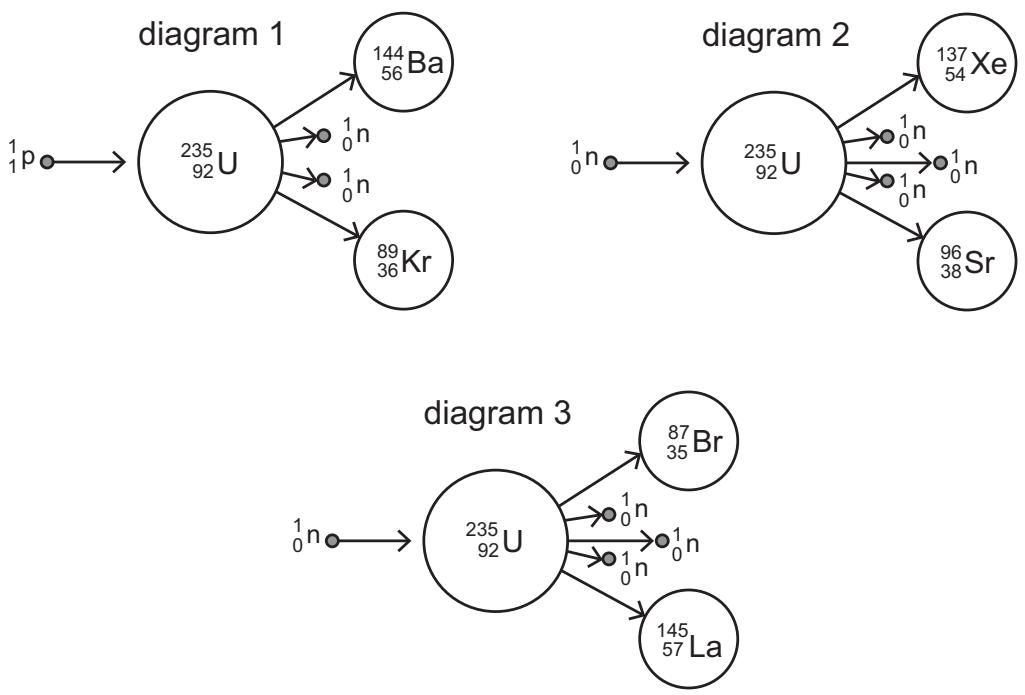
Which of the diagrams, if any, could represent this process?
- A.none of them
- B.1 only
- C.2 only
- D.3 only
- E.1 and 2 only
- F.1 and 3 only
- G.2 and 3 only
- H.1, 2 and 3
Answer: C
Question 7
1 markThe mean age of the twenty members of a running club is exactly 28.
The mean age increases by exactly 2 years when two new members join.
What is the mean age of the two new members?
The mean age increases by exactly 2 years when two new members join.
What is the mean age of the two new members?
- A.20 years
- B.22 years
- C.30 years
- D.40 years
- E.50 years
- F.52 years
Answer: E
Question 8
1 markA circuit consists of a 5.0 resistor and a variable resistor connected in series with a 24 V battery. The variable resistor has a minimum resistance of 3.0 and a maximum resistance of 15 . The battery and the connecting wires have negligible resistance.
What is the maximum power dissipated in the 5.0 resistor?
What is the maximum power dissipated in the 5.0 resistor?
- A.7.2 W
- B.18 W
- C.27 W
- D.45 W
- E.72 W
- F.75 W
Answer: D
Question 9
1 markA medical scanner is bought for £15000.
The value of the scanner depreciates by 20% every year.
By how much has the scanner reduced in value after 2 years?
The value of the scanner depreciates by 20% every year.
By how much has the scanner reduced in value after 2 years?
- A.£600
- B.£3000
- C.£5400
- D.£6000
- E.£9000
- F.£9600
- G.£12000
Answer: C
Question 10
1 markThe total power radiated by a star is given by:
where is the radius of the star, is its surface temperature and is a constant.
The power currently radiated by the Sun is W. Towards the end of the Sun's life its radius will increase by a factor of a hundred and its surface temperature will decrease by a factor of two.
What will be the power radiated by the Sun when these changes have occurred?
where is the radius of the star, is its surface temperature and is a constant.
The power currently radiated by the Sun is W. Towards the end of the Sun's life its radius will increase by a factor of a hundred and its surface temperature will decrease by a factor of two.
What will be the power radiated by the Sun when these changes have occurred?
- A. W
- B. W
- C. W
- D. W
- E. W
- F. W
- G. W
- H. W
Answer: D
Question 11
1 markThe point A is 4 km due East of the point B.
The bearing of the point C from A is 330° and the bearing of C from B is 060°
Find the distance BC.
The bearing of the point C from A is 330° and the bearing of C from B is 060°
Find the distance BC.
- A.2 km
- B. km
- C.4 km
- D. km
- E. km
Answer: B
Question 12
1 markA transverse wave travelling through a medium has a frequency of 5.0 Hz, a wavelength of 4.0 cm and an amplitude of 3.0 cm.
What is the total distance travelled by a particle of the medium in one minute?
What is the total distance travelled by a particle of the medium in one minute?
- A.900 cm
- B.1200 cm
- C.1800 cm
- D.2400 cm
- E.3600 cm
- F.4800 cm
Answer: E
Question 13
1 markThe quantities and are positive.
is inversely proportional to the square root of .
When , .
What is the value of when ?
is inversely proportional to the square root of .
When , .
What is the value of when ?
- A.
- B.2
- C.
- D.
- E.12
- F.16
Answer: F
Question 14
1 markA motor is used to lift a mass of using a pulley system as shown in the diagram. The pulley is secured to the roof using a coupling.
The motor needs to cause the mass to accelerate upwards at .
What is the minimum tension force that the coupling must be able to withstand without breaking?
(The gravitational field strength is . The pulley system is frictionless and has negligible mass. The rope has negligible mass and is inextensible.)
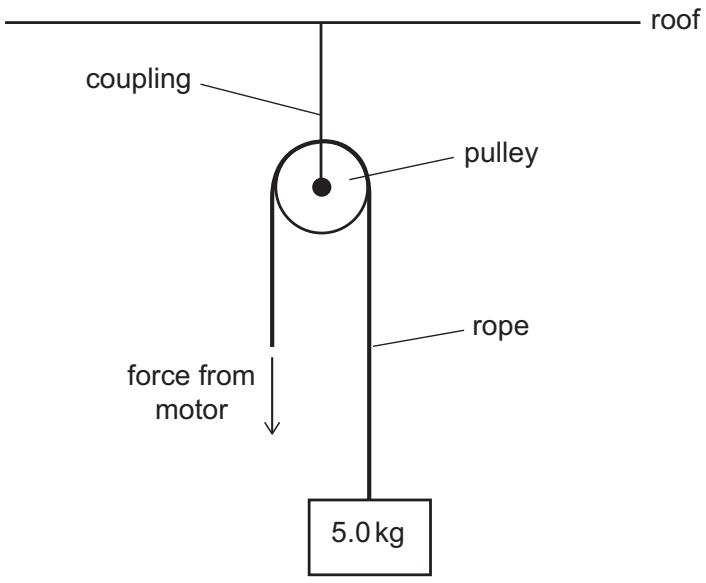
The motor needs to cause the mass to accelerate upwards at .
What is the minimum tension force that the coupling must be able to withstand without breaking?
(The gravitational field strength is . The pulley system is frictionless and has negligible mass. The rope has negligible mass and is inextensible.)
- A.4.0 N
- B.8.0 N
- C.46 N
- D.50 N
- E.54 N
- F.92 N
- G.104 N
- H.108 N
Answer: H
Question 15
1 markIn a trapezium PQRS, the parallel sides are PQ and RS.
, and the vertical height .
The area of the trapezium is .
What is the length of RS?
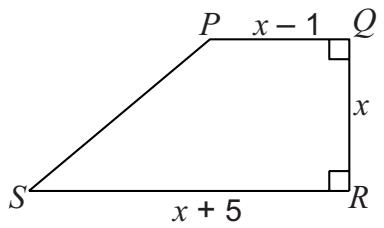
, and the vertical height .
The area of the trapezium is .
What is the length of RS?
- A.9 cm
- B.10 cm
- C.11 cm
- D.12 cm
- E.15 cm
- F.17 cm
Answer: E
Question 16
1 markA heater is connected in series with a resistor and a 6.0 V battery in the circuit shown.
The total resistance of the circuit is 15 . In 3.0 minutes, 180 J of electrical energy is transferred into other forms in the heater.
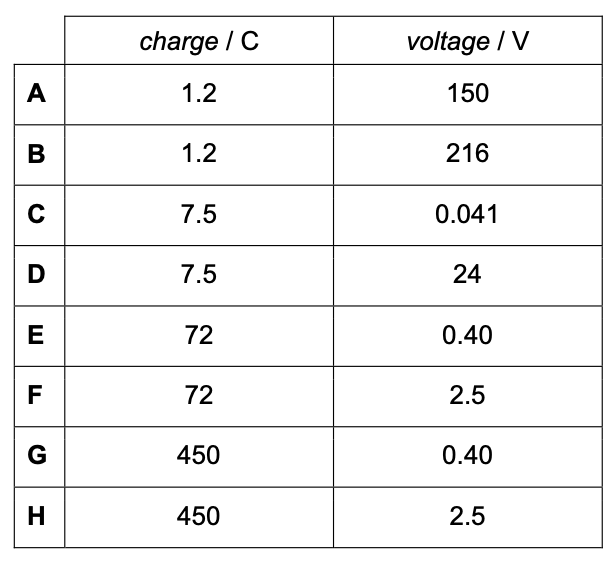
How much charge flows through the heater in the 3.0 minutes and what is the voltage across the heater?
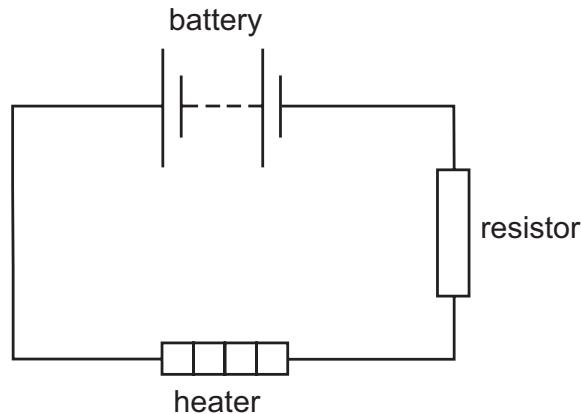
The total resistance of the circuit is 15 . In 3.0 minutes, 180 J of electrical energy is transferred into other forms in the heater.
How much charge flows through the heater in the 3.0 minutes and what is the voltage across the heater?
- A.charge / C: 1.2, voltage / V: 150
- B.charge / C: 1.2, voltage / V: 216
- C.charge / C: 7.5, voltage / V: 0.041
- D.charge / C: 7.5, voltage / V: 24
- E.charge / C: 72, voltage / V: 0.40
- F.charge / C: 72, voltage / V: 2.5
- G.charge / C: 450, voltage / V: 0.40
- H.charge / C: 450, voltage / V: 2.5
Answer: F
Question 17
1 markMake the subject of the formula:
- A.
- B.
- C.
- D.
- E.
- F.
Answer: B
Question 18
1 markA cubic block has a hole through it with a square cross-section. The dimensions are shown on the diagram. The weight of the block is 30 N. The outer cube has a side length of 10 cm, and the inner square hole has a side length of 5.0 cm.
What is the density of the material from which the block is made?
(The gravitational field strength is .)
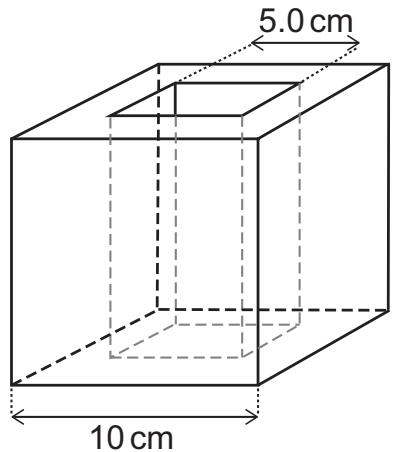
What is the density of the material from which the block is made?
(The gravitational field strength is .)
- A.
- B.
- C.
- D.
- E.
- F.
- G.
- H.
Answer: F
Question 19
1 markA thin rectangular sheet of metal 10 m by 5 m is made into an open ended cylinder by joining the edges PS and QR.
The height of the cylinder is 10 m.
What is the volume, in cubic metres, enclosed by this cylinder?
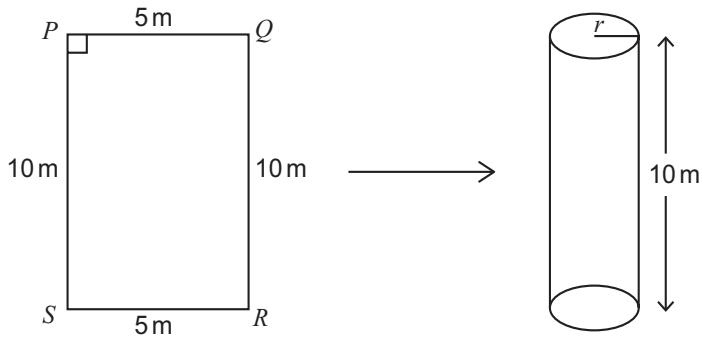
The height of the cylinder is 10 m.
What is the volume, in cubic metres, enclosed by this cylinder?
- A.
- B.
- C.
- D.
- E.
- F.
Answer: C
Question 20
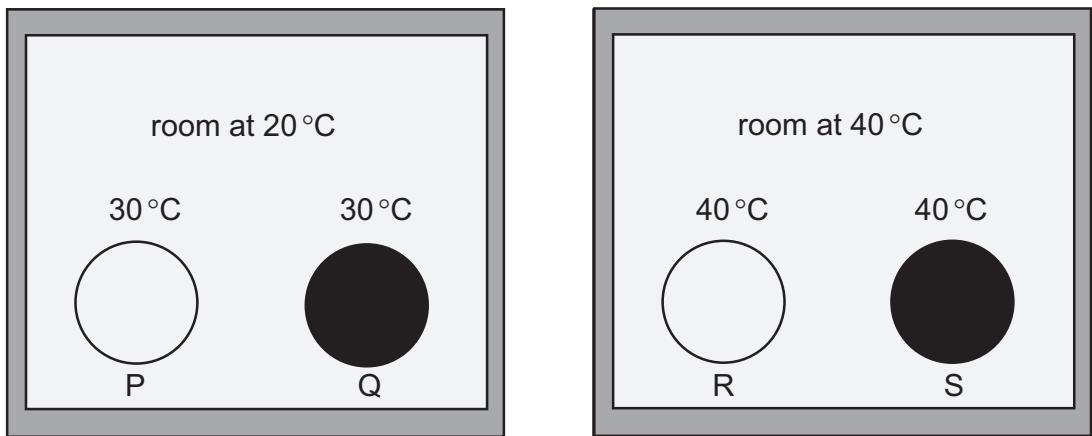
1 markThe diagram shows four solid steel balls P, Q, R and S which are of identical size.
Balls P and R have shiny surfaces. Balls Q and S have dull surfaces.
Balls P and Q are in a room at 20 °C. Balls R and S are in a room at 40 °C.
The temperature of each ball at a given moment in time is shown on the diagram.
(Diagram shows: Ball P, shiny, 30°C in a 20°C room. Ball Q, dull, 30°C in a 20°C room. Ball R, shiny, 40°C in a 40°C room. Ball S, dull, 40°C in a 40°C room.)
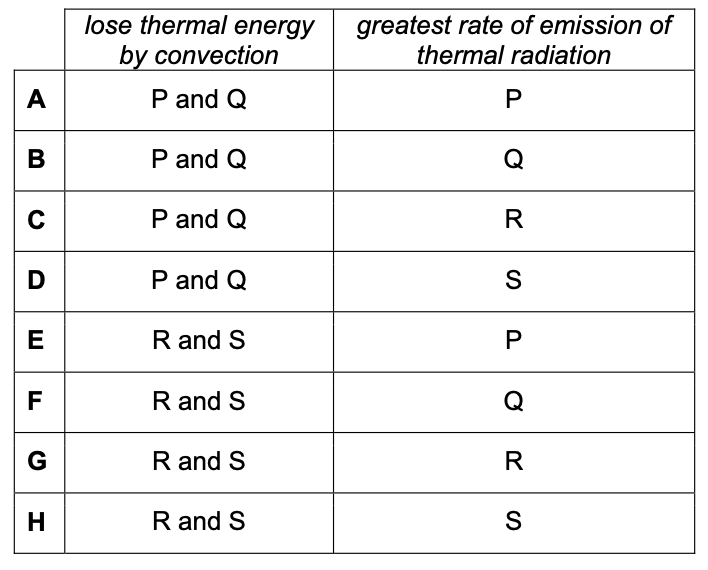
Which two balls lose thermal energy by convection, and which ball emits thermal radiation at the greatest rate?
Balls P and R have shiny surfaces. Balls Q and S have dull surfaces.
Balls P and Q are in a room at 20 °C. Balls R and S are in a room at 40 °C.
The temperature of each ball at a given moment in time is shown on the diagram.
(Diagram shows: Ball P, shiny, 30°C in a 20°C room. Ball Q, dull, 30°C in a 20°C room. Ball R, shiny, 40°C in a 40°C room. Ball S, dull, 40°C in a 40°C room.)
Which two balls lose thermal energy by convection, and which ball emits thermal radiation at the greatest rate?
- A.lose thermal energy by convection: P and Q, greatest rate of emission of thermal radiation: P
- B.lose thermal energy by convection: P and Q, greatest rate of emission of thermal radiation: Q
- C.lose thermal energy by convection: P and Q, greatest rate of emission of thermal radiation: R
- D.lose thermal energy by convection: P and Q, greatest rate of emission of thermal radiation: S
- E.lose thermal energy by convection: R and S, greatest rate of emission of thermal radiation: P
- F.lose thermal energy by convection: R and S, greatest rate of emission of thermal radiation: Q
- G.lose thermal energy by convection: R and S, greatest rate of emission of thermal radiation: R
- H.lose thermal energy by convection: R and S, greatest rate of emission of thermal radiation: S
Answer: D
Question 21
1 markWhich one of the following is a simplification of ?
- A.
- B.
- C.
- D.
- E.
- F.
Answer: A
Question 22
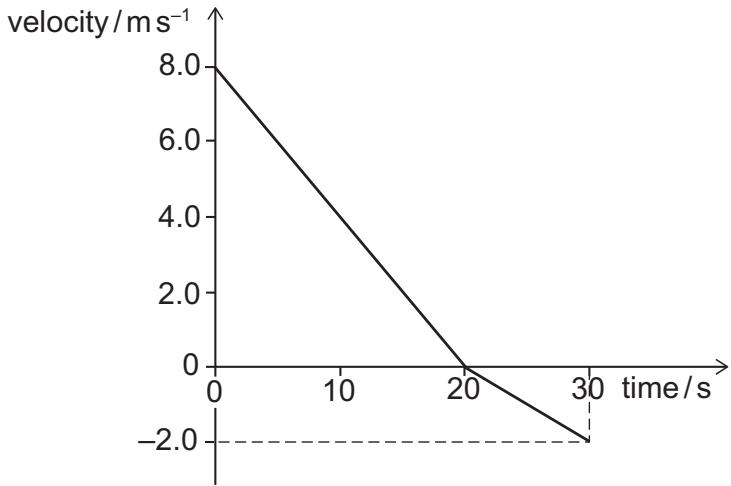
1 markThe diagram shows the velocity-time graph for an object travelling in a straight line over a period of 30 s.
(The graph shows velocity starting at 8.0 m/s at t=0, decreasing linearly to 0 m/s at t=20 s, and further decreasing linearly to -2.0 m/s at t=30 s.)
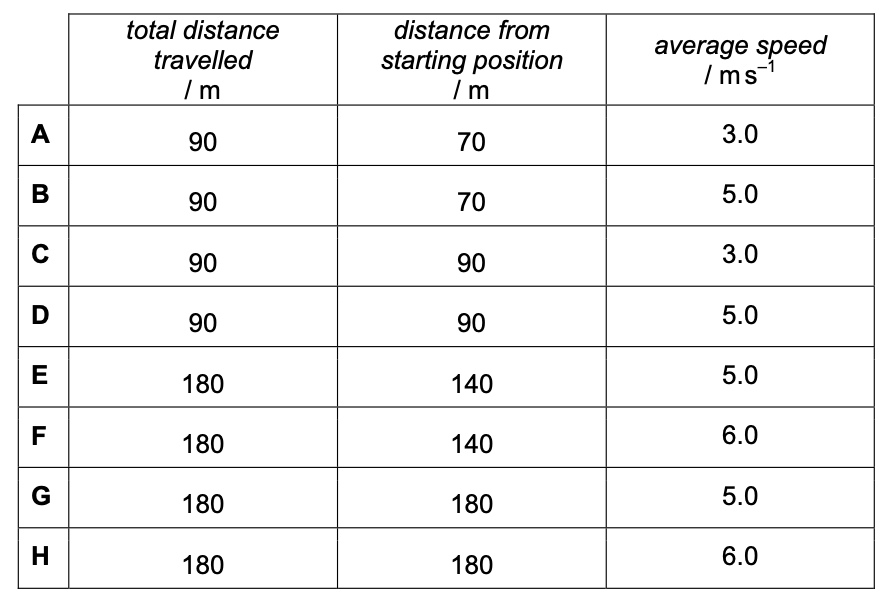
What total distance did the object travel in the 30s, how far from its starting position was it at the end of the 30s, and what was its average speed over the 30s?
(The graph shows velocity starting at 8.0 m/s at t=0, decreasing linearly to 0 m/s at t=20 s, and further decreasing linearly to -2.0 m/s at t=30 s.)
What total distance did the object travel in the 30s, how far from its starting position was it at the end of the 30s, and what was its average speed over the 30s?
- A.total distance travelled / m: 90, distance from starting position / m: 70, average speed / ms⁻¹: 3.0
- B.total distance travelled / m: 90, distance from starting position / m: 70, average speed / ms⁻¹: 5.0
- C.total distance travelled / m: 90, distance from starting position / m: 90, average speed / ms⁻¹: 3.0
- D.total distance travelled / m: 90, distance from starting position / m: 90, average speed / ms⁻¹: 5.0
- E.total distance travelled / m: 180, distance from starting position / m: 140, average speed / ms⁻¹: 5.0
- F.total distance travelled / m: 180, distance from starting position / m: 140, average speed / ms⁻¹: 6.0
- G.total distance travelled / m: 180, distance from starting position / m: 180, average speed / ms⁻¹: 5.0
- H.total distance travelled / m: 180, distance from starting position / m: 180, average speed / ms⁻¹: 6.0
Answer: A
Question 23
1 markDuring summer activities week 120 students each chose one activity from swimming, archery, and tennis.
46 of the students were girls.
36 of the students chose tennis, and of these were boys; 25 girls chose swimming, and 27 students chose archery.
A boy is picked at random. What is the probability that he chose swimming?
46 of the students were girls.
36 of the students chose tennis, and of these were boys; 25 girls chose swimming, and 27 students chose archery.
A boy is picked at random. What is the probability that he chose swimming?
- A.
- B.
- C.
- D.
- E.
Answer: D
Question 24
1 markBronze is a mixture of tin and copper.
A particular sample of bronze contains 10% tin by volume. (In other words, 10% of the total volume of the sample is tin and 90% of it is copper.)
What percentage of the mass of the sample is tin?
(Density of tin = and density of copper = .)
A particular sample of bronze contains 10% tin by volume. (In other words, 10% of the total volume of the sample is tin and 90% of it is copper.)
What percentage of the mass of the sample is tin?
(Density of tin = and density of copper = .)
- A.
- B.
- C.
- D.
- E.
- F.
- G.
- H.
Answer: G
Question 25
1 markWhich one of the following expressions is equivalent to ?
- A.
- B.
- C.
- D.
- E.
- F.
Answer: D
Question 26
1 markWhen a stationary uranium-238 nucleus decays by alpha emission it forms a nucleus of thorium-234. The total kinetic energy produced by the decay is .
What is the kinetic energy of the alpha particle?
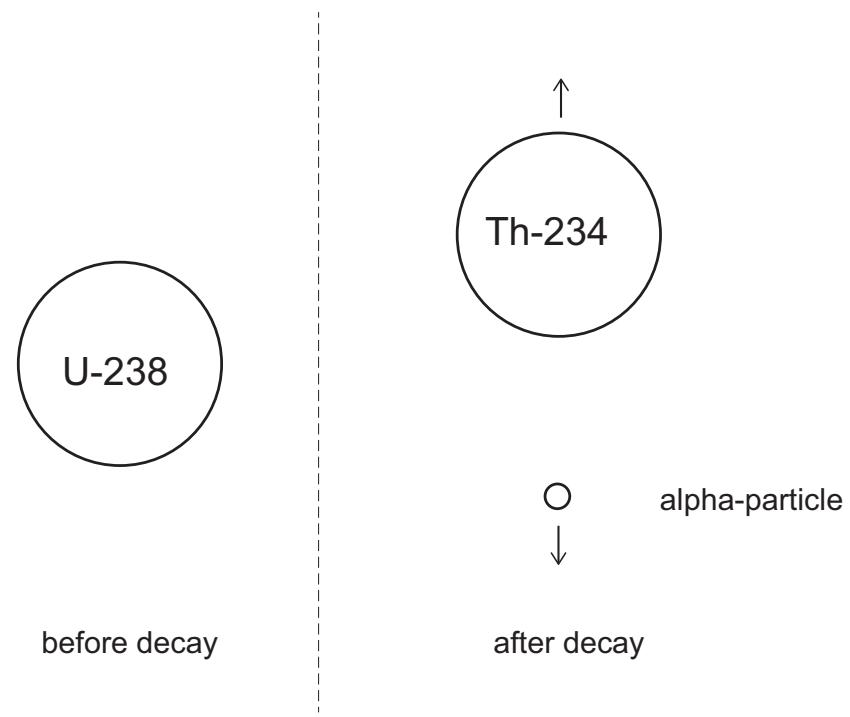
What is the kinetic energy of the alpha particle?
- A.
- B.
- C.
- D.
- E.
Answer: D
Question 27
1 markIn the diagram below, PQRS is part of a regular polygon.
The polygon has sides.
The side PQ is extended to T such that PQT is a straight line.
The length of RQ is the same as the length of RT.
Find an equation for in terms of , where is the size of angle in degrees.
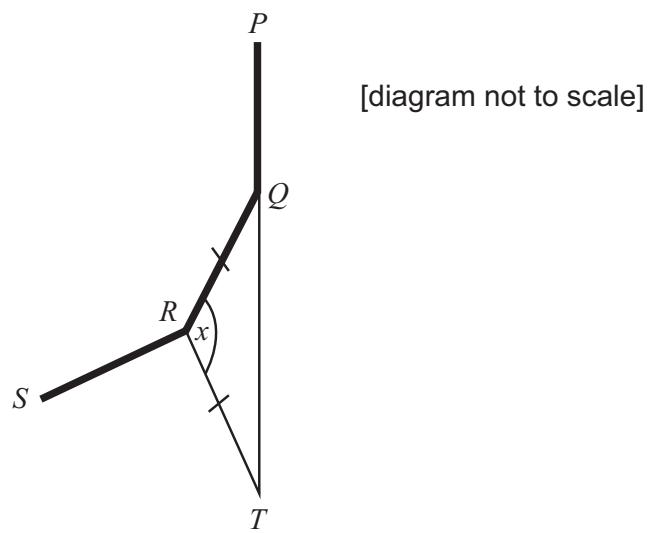
The polygon has sides.
The side PQ is extended to T such that PQT is a straight line.
The length of RQ is the same as the length of RT.
Find an equation for in terms of , where is the size of angle in degrees.
- A.
- B.
- C.
- D.
- E.
- F.
- G.
Answer: E
Question 28
1 markA student carries out an experiment to measure the speed of sound. A loudspeaker that emits sound in all directions is placed between two buildings that are 128 m apart as shown. The student and loudspeaker are 48 m from one of the buildings.
The loudspeaker is connected to a signal generator that causes it to emit regular clicks. The student notices that each click results in two echoes, one from each building. The rate at which the clicks are produced is gradually increased from zero until each echo coincides with a new click being emitted by the loudspeaker.
What is the frequency of emission of clicks when this happens?
(The speed of sound in air = .)
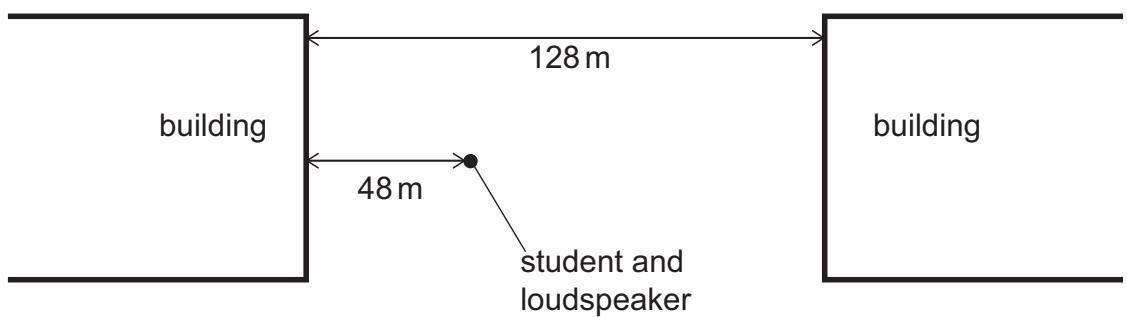
The loudspeaker is connected to a signal generator that causes it to emit regular clicks. The student notices that each click results in two echoes, one from each building. The rate at which the clicks are produced is gradually increased from zero until each echo coincides with a new click being emitted by the loudspeaker.
What is the frequency of emission of clicks when this happens?
(The speed of sound in air = .)
- A.2.0 Hz
- B.2.5 Hz
- C.3.3 Hz
- D.4.0 Hz
- E.5.3 Hz
- F.6.7 Hz
- G.10 Hz
Answer: G
Question 29
1 markWhen is substituted in the expression the result is 0.
When is substituted into the same expression, the result is -3.5.
Find all possible value(s) of .
When is substituted into the same expression, the result is -3.5.
Find all possible value(s) of .
- A.
- B. or
- C.
- D.
- E.there are no values for
Answer: C
Question 30
1 markA parachutist is falling at terminal speed with his parachute open. The diagrams show, separately, the vertical forces acting on the parachute and the vertical forces acting on the parachutist.
The letters L, M, N, P, Q and R represent the magnitude of each force as indicated.
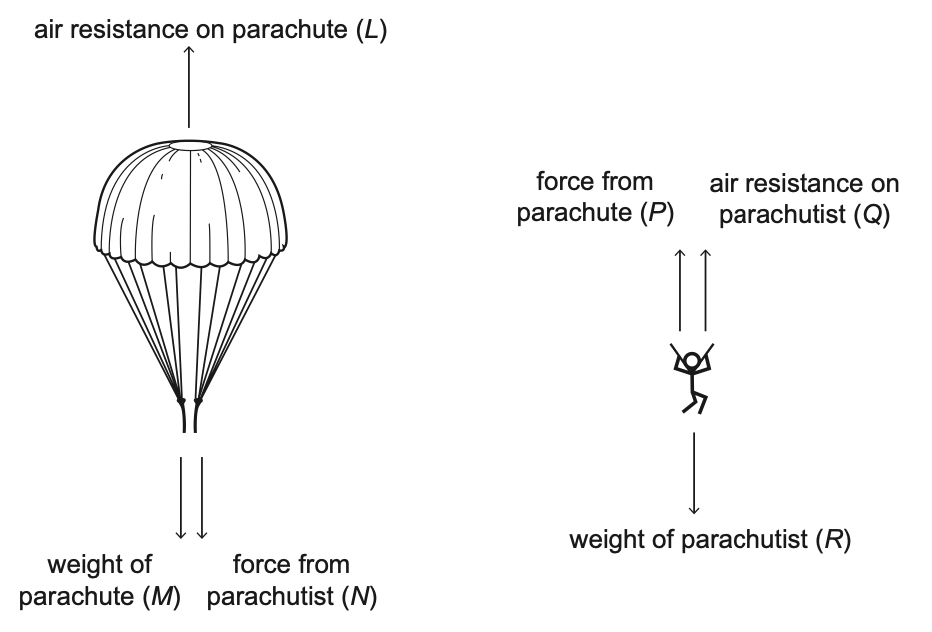
Consider the following equations:
Equation 1:
Equation 2:
Equation 3:
Equation 4:
Equation 5:
Which of these equations, if any, is/are the direct result of the application of Newton's Third Law to this situation?
The letters L, M, N, P, Q and R represent the magnitude of each force as indicated.
Consider the following equations:
Equation 1:
Equation 2:
Equation 3:
Equation 4:
Equation 5:
Which of these equations, if any, is/are the direct result of the application of Newton's Third Law to this situation?
- A.none of them
- B.3 only
- C.4 only
- D.5 only
- E.1 and 2 only
- F.3 and 4 only
- G.1, 2 and 5 only
- H.1, 2, 3, 4 and 5
Answer: C
Question 31
1 markA square PQRS is drawn above the x-axis with the side PQ on the x-axis.
P is the point (–5, 0) and Q is the point (1, 0).
A circle is drawn inside the square with diameter equal in length to the side of the square.
Which one of the following is an equation of the circle?
P is the point (–5, 0) and Q is the point (1, 0).
A circle is drawn inside the square with diameter equal in length to the side of the square.
Which one of the following is an equation of the circle?
- A.
- B.
- C.
- D.
- E.
- F.
- G.
- H.
Answer: C
Question 32
1 markA crate has a total mass of 800 kg, including its contents. A helicopter of mass 4200 kg is carrying the crate using a light inextensible rope as shown.
The helicopter and crate are accelerating upwards at .
What is the tension in the rope?
(The gravitational field strength is ; air resistance can be ignored.)
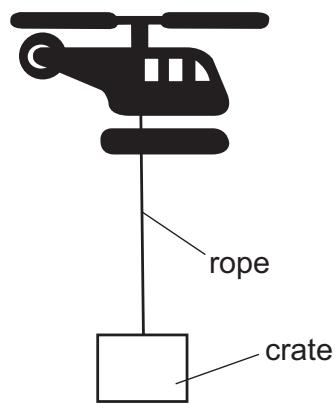
The helicopter and crate are accelerating upwards at .
What is the tension in the rope?
(The gravitational field strength is ; air resistance can be ignored.)
- A.6400 N
- B.8000 N
- C.9600 N
- D.18000 N
- E.40000 N
- F.42000 N
- G.50000 N
- H.60000 N
Answer: C
Question 33
1 markThe first term of a convergent geometric series is 8.
The fifth term is 2.
The sixth term is real and positive.
What is the sum to infinity of this series?
(The sum to infinity of a convergent geometric series is given by , where is the first term and is the common ratio.)
The fifth term is 2.
The sixth term is real and positive.
What is the sum to infinity of this series?
(The sum to infinity of a convergent geometric series is given by , where is the first term and is the common ratio.)
- A.
- B.
- C.
- D.
- E.16
- F.
- G.
Answer: C
Question 34
1 markA shopper pushes a supermarket trolley a distance of 15 m in a straight line across a level, horizontal surface. The shopper applies a constant force of 50 N at an angle of 37° below the horizontal. The total weight of the trolley and its contents is 350 N.
What is the magnitude of the total vertical force that the surface exerts on the trolley and how much work is done by the pushing force?
(You may use the approximations ; .)
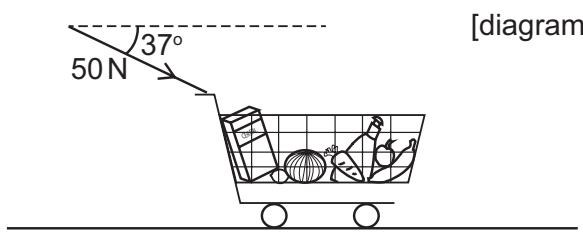
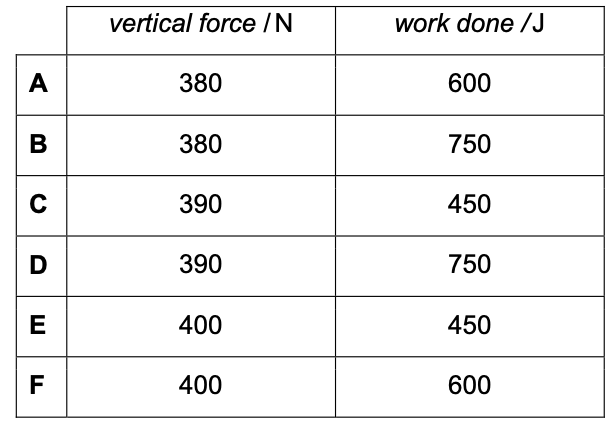
What is the magnitude of the total vertical force that the surface exerts on the trolley and how much work is done by the pushing force?
(You may use the approximations ; .)
- A.vertical force / N: 380, work done / J: 600
- B.vertical force / N: 380, work done / J: 750
- C.vertical force / N: 390, work done / J: 450
- D.vertical force / N: 390, work done / J: 750
- E.vertical force / N: 400, work done / J: 450
- F.vertical force / N: 400, work done / J: 600
Answer: A
Question 35
1 markTangents are drawn from a point P to a circle of radius 10 cm.
The centre of the circle is C and the distance PC is 20 cm.
Which one of the following is an expression for the shaded area in square centimetres?
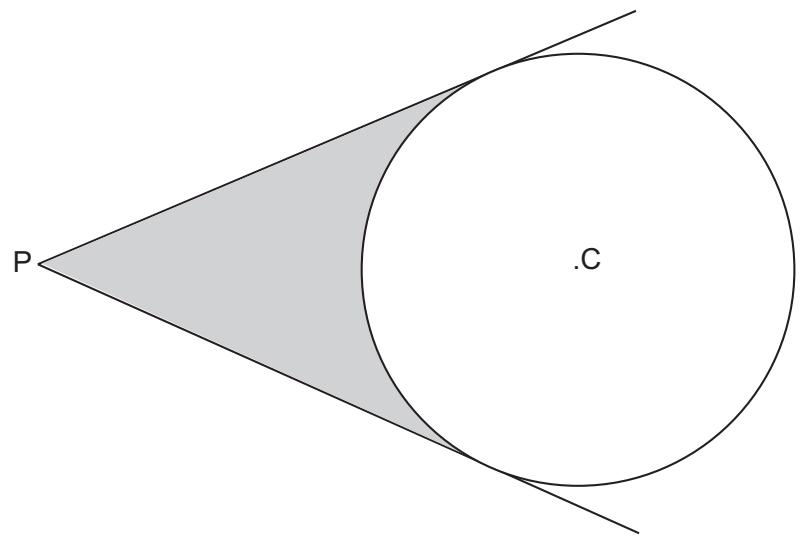
The centre of the circle is C and the distance PC is 20 cm.
Which one of the following is an expression for the shaded area in square centimetres?
- A.
- B.
- C.
- D.
- E.
- F.
Answer: A
Question 36
1 markA plank of non-uniform density which has a mass of 15 kg is used to make a see-saw. A pivot is placed under the centre of the plank as shown on the diagram.
A boy of mass 35 kg sits at one end of the plank with his centre of gravity 1.20 m from the pivot. The see-saw balances when a woman of mass 60 kg sits on the plank on the other side of the pivot. Her centre of gravity is 0.80 m from the pivot.
Where is the centre of gravity of the plank and what is the magnitude of the force between the pivot and the plank?
(The gravitational field strength is .)
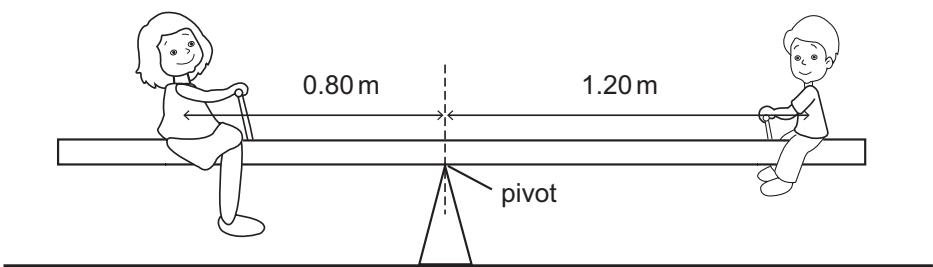
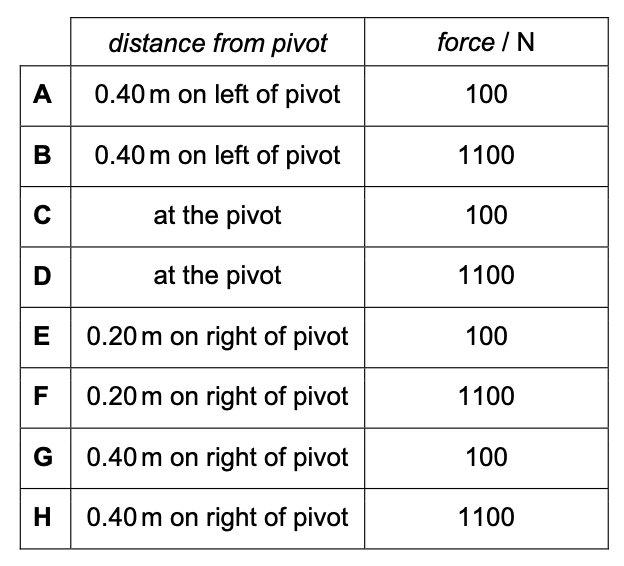
A boy of mass 35 kg sits at one end of the plank with his centre of gravity 1.20 m from the pivot. The see-saw balances when a woman of mass 60 kg sits on the plank on the other side of the pivot. Her centre of gravity is 0.80 m from the pivot.
Where is the centre of gravity of the plank and what is the magnitude of the force between the pivot and the plank?
(The gravitational field strength is .)
- A.distance from pivot: 0.40 m on left of pivot, force / N: 100
- B.distance from pivot: 0.40 m on left of pivot, force / N: 1100
- C.distance from pivot: at the pivot, force / N: 100
- D.distance from pivot: at the pivot, force / N: 1100
- E.distance from pivot: 0.20 m on right of pivot, force / N: 100
- F.distance from pivot: 0.20 m on right of pivot, force / N: 1100
- G.distance from pivot: 0.40 m on right of pivot, force / N: 100
- H.distance from pivot: 0.40 m on right of pivot, force / N: 1100
Answer: H
Question 37
1 markGiven that , which one of the following is true?
- A. or
- B. or
- C. or
- D. or
Answer: D
Question 38
1 markA car of mass 200 kg on a fairground ride travels at a speed of at point X. The car is allowed to move down a sloping section of track without any energy input. The heights above the ground of points X and Y are shown. When the car reaches point Y its speed is .
(Diagram shows point X at height 8.0 m and point Y at height 2.0 m.)
How much energy is transferred in overcoming resistive forces as the car travels from X to Y?
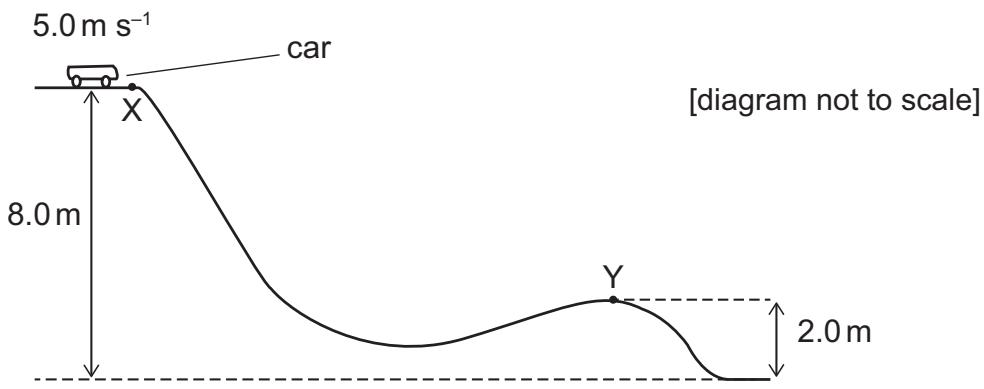
(Diagram shows point X at height 8.0 m and point Y at height 2.0 m.)
How much energy is transferred in overcoming resistive forces as the car travels from X to Y?
- A.3900 J
- B.6400 J
- C.7900 J
- D.10400 J
- E.11200 J
Answer: B
Question 39
1 markThe complete set of values of for which the equation has two real distinct roots is
- A.no values of
- B.
- C.
- D.
- E.
- F.
- G.
- H.all values of
Answer: G
Question 40
1 markThe diagram shows a uniform, solid, heavy cube with side . The cube rests with one of its edges in contact with a table that is perfectly level. A horizontal force acts on another edge of the cube, and the cube is stationary. The cube is tilted at an angle of 30° to the horizontal.
Below are four statements about the forces on the cube.
1 It is possible that there is no frictional force between the cube and the table.
2 There must be a frictional force acting to the left between the cube and the table.
3 There must be a frictional force acting to the right between the cube and the table.
4 Force has a clockwise moment about the edge in contact with the table equal to .
Which of the statements is/are correct?
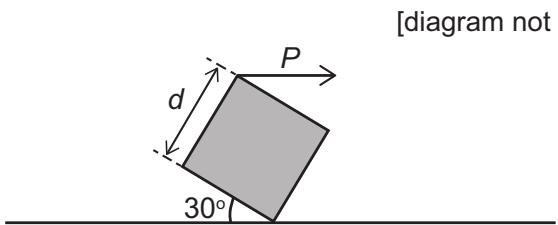
Below are four statements about the forces on the cube.
1 It is possible that there is no frictional force between the cube and the table.
2 There must be a frictional force acting to the left between the cube and the table.
3 There must be a frictional force acting to the right between the cube and the table.
4 Force has a clockwise moment about the edge in contact with the table equal to .
Which of the statements is/are correct?
- A.1 only
- B.2 only
- C.3 only
- D.1 and 4 only
- E.2 and 4 only
- F.3 and 4 only
Answer: B
Question 41
1 markThe straight line with equation , where , is perpendicular to the line with equation .
The lines cut the x-axis at the points L and M respectively. The length of LM is 5 units.
What is the value of given that ?
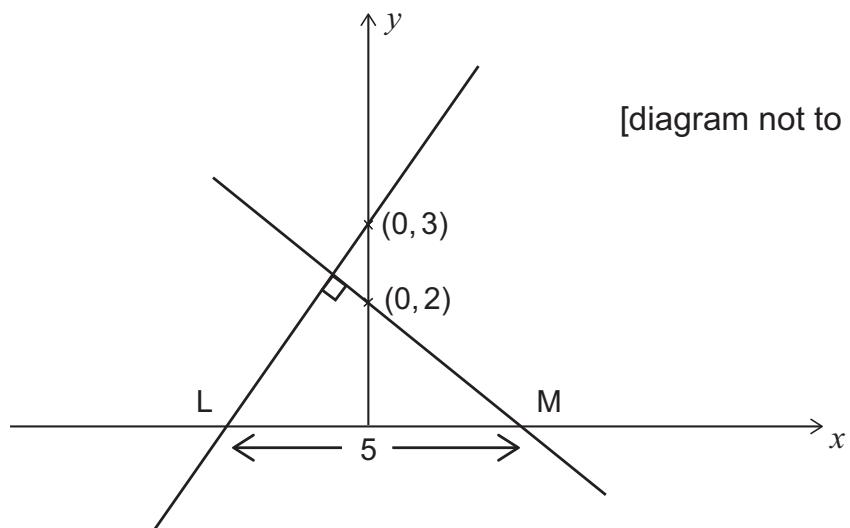
The lines cut the x-axis at the points L and M respectively. The length of LM is 5 units.
What is the value of given that ?
- A.
- B.
- C.
- D.
- E.
- F.
Answer: D
Question 42
1 markThe diagram shows two identical blocks, each of mass , in two different arrangements.
(Arrangement 1 shows two blocks stacked vertically. The bottom block has height b. The top block has height a.)
(Arrangement 2 shows the two blocks side by side on the ground.)
Which expression gives:
?
(g is the gravitational field strength.)
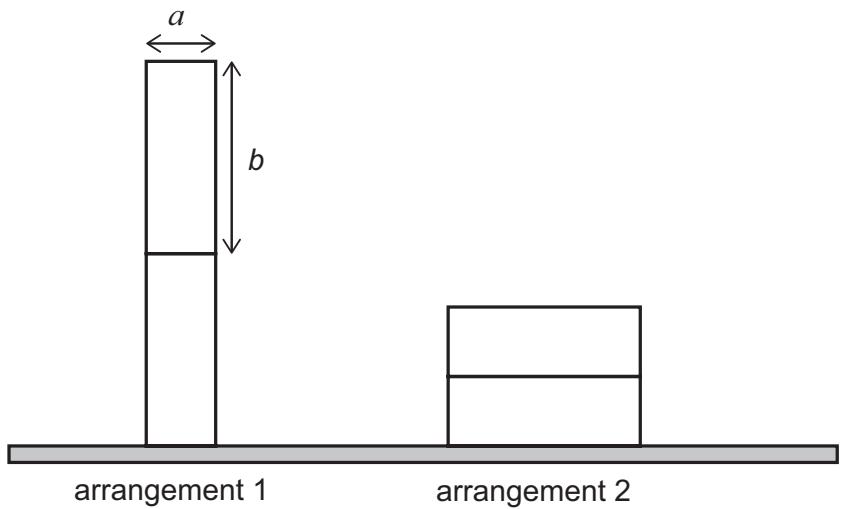
(Arrangement 1 shows two blocks stacked vertically. The bottom block has height b. The top block has height a.)
(Arrangement 2 shows the two blocks side by side on the ground.)
Which expression gives:
?
(g is the gravitational field strength.)
- A.
- B.
- C.
- D.
- E.
- F.
Answer: A
Question 43
1 mark where is a positive constant.
Find the complete set of values of for which is an increasing function.
Find the complete set of values of for which is an increasing function.
- A.
- B.
- C.
- D.
- E.
- F.
- G.
- H.
Answer: G
Question 44
1 markAn object is fired vertically upwards from the ground at time in still air at a speed of .
On the way up, what is the height of the object above the ground when it has a speed of , and at what time does it reach this height on the way down?
(The gravitational field strength is . Air resistance can be ignored.)
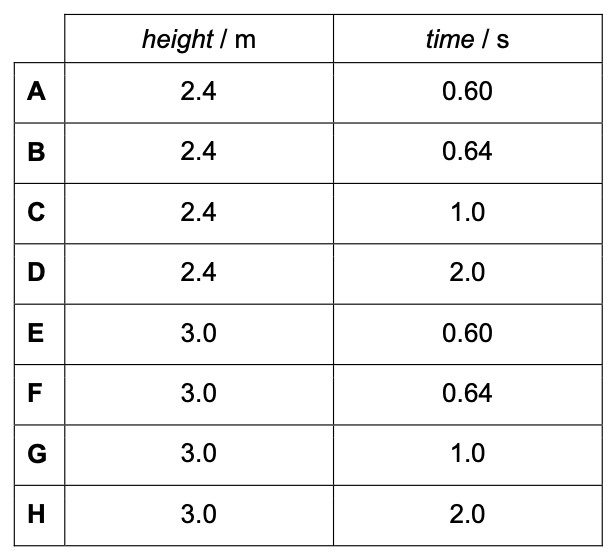
On the way up, what is the height of the object above the ground when it has a speed of , and at what time does it reach this height on the way down?
(The gravitational field strength is . Air resistance can be ignored.)
- A.height / m: 2.4, time / s: 0.60
- B.height / m: 2.4, time / s: 0.64
- C.height / m: 2.4, time / s: 1.0
- D.height / m: 2.4, time / s: 2.0
- E.height / m: 3.0, time / s: 0.60
- F.height / m: 3.0, time / s: 0.64
- G.height / m: 3.0, time / s: 1.0
- H.height / m: 3.0, time / s: 2.0
Answer: G
Question 45
1 markThe curve is translated by the vector and then reflected in the line .
Which one of the following is an equation of the resulting curve?
Which one of the following is an equation of the resulting curve?
- A.
- B.
- C.
- D.
- E.
- F.
- G.
- H.
Answer: E
Question 46
1 markThe diagram shows a ball P, of mass 4.0 kg, moving to the right at directly towards a stationary ball Q, of mass 2.0 kg.
The balls collide but do not join together. Immediately after the collision ball Q moves at to the right.
What is the velocity of ball P immediately after the collision, and how much kinetic energy in total is lost during the collision?
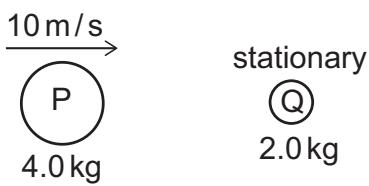
The balls collide but do not join together. Immediately after the collision ball Q moves at to the right.
What is the velocity of ball P immediately after the collision, and how much kinetic energy in total is lost during the collision?
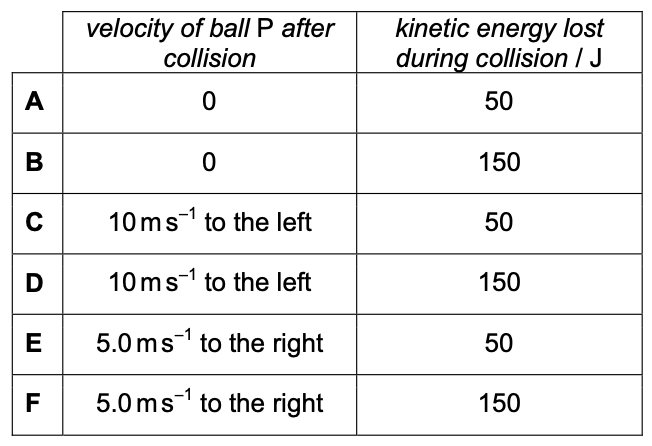
- A.velocity of ball P after collision: 0, kinetic energy lost during collision / J: 50
- B.velocity of ball P after collision: 0, kinetic energy lost during collision / J: 150
- C.velocity of ball P after collision: to the left, kinetic energy lost during collision / J: 50
- D.velocity of ball P after collision: to the left, kinetic energy lost during collision / J: 150
- E.velocity of ball P after collision: to the right, kinetic energy lost during collision / J: 50
- F.velocity of ball P after collision: to the right, kinetic energy lost during collision / J: 150
Answer: E
Question 47
1 markThe complete set of values of for which is
- A.
- B.
- C.
- D.
- E.
Answer: C
Question 48
1 markA point object of mass 2.0 kg is at rest on a level, horizontal surface. The coefficient of friction between the object and the surface is 0.25.
Two horizontal forces at right-angles to each other, with magnitudes 9.0 N and 12.0 N, are applied simultaneously to the object.
What is the magnitude of the acceleration of the object as it begins to move?
(The gravitational field strength is .)
Two horizontal forces at right-angles to each other, with magnitudes 9.0 N and 12.0 N, are applied simultaneously to the object.
What is the magnitude of the acceleration of the object as it begins to move?
(The gravitational field strength is .)
- A.
- B.
- C.
- D.
- E.
- F.
Answer: A
Question 49
1 markA cursor starts at the point (0, 10) and moves parallel to the x-axis in the negative direction.
What is the minimum distance parallel to the y-axis between the cursor and the graph of ?
What is the minimum distance parallel to the y-axis between the cursor and the graph of ?
- A.0
- B.5
- C.25
- D.69
- E.133
Answer: B
Question 50
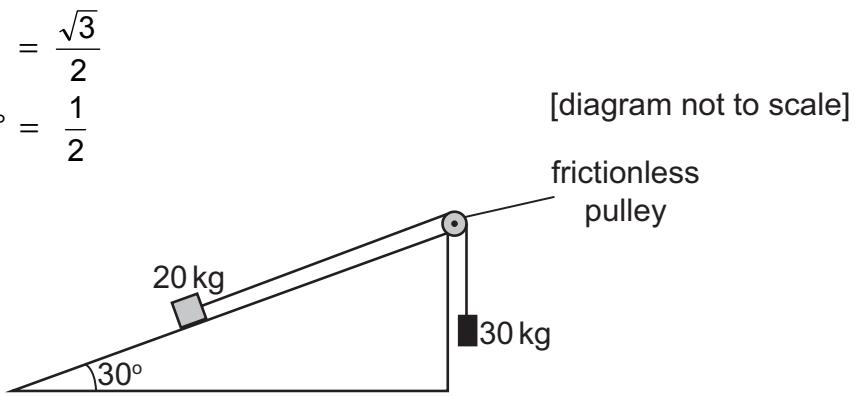
1 markAn object of mass 20 kg is pulled up a rough plane inclined at 30° to the horizontal by a light, inextensible cable attached via a frictionless pulley to a freely-falling 30 kg mass. The acceleration of the object along the plane is .
What is the frictional force between the object and the plane?
(Air resistance and the mass of the pulley can be ignored. The gravitational field strength is .)
What is the frictional force between the object and the plane?
(Air resistance and the mass of the pulley can be ignored. The gravitational field strength is .)
- A.25 N
- B.50 N
- C.75 N
- D.100 N
- E.150 N
- F.175 N
- G.250 N
Answer: C
Question 51
1 markWhat is the area enclosed by the line and the curve ?
- A.4
- B.8
- C.10
- D.11
- E.14
- F.20
Answer: A
Question 52
1 markA spacecraft of initial total mass 4000 kg is travelling relative to the Earth at a constant speed of .
It ejects some fuel backwards in a sudden burst at a speed relative to the spacecraft of . As a result of this, the speed of the spacecraft immediately after the fuel is ejected increases to .
What is the mass of fuel ejected?
It ejects some fuel backwards in a sudden burst at a speed relative to the spacecraft of . As a result of this, the speed of the spacecraft immediately after the fuel is ejected increases to .
What is the mass of fuel ejected?
- A.22 kg
- B.34 kg
- C.40 kg
- D.50 kg
- E.200 kg
- F.210 kg
Answer: E
Question 53
1 markA curve has equation
What is the complete set of values of the constant for which the equation
has exactly four distinct real roots?
What is the complete set of values of the constant for which the equation
has exactly four distinct real roots?
- A.no values of
- B.
- C.
- D.
- E.
- F.all values of
Answer: C
Question 54
1 markAn object of weight 40 N hangs from the end of a light inextensible string of length 0.35 m, which is attached to the ceiling. A constant horizontal force of 30 N is applied to the object, causing it to move to a new equilibrium position with the string no longer vertical.
By how much has the gravitational potential energy of the object increased as a result of its change of position?
By how much has the gravitational potential energy of the object increased as a result of its change of position?
- A.2.1 J
- B.2.8 J
- C.3.5 J
- D.4.2 J
- E.4.9 J
- F.5.6 J
Answer: B