ENGAA 2018 D564/11
54 questions54 marks80Updated August 2025
The ENGAA 2018 D564/11 paper in full: all 54 questions, each with its answer. ENGAA is the Engineering Admissions Assessment. Sit it cold under exam timing, mark it, then work back through anything you missed using the solutions below.
Download the original PDF →Questions and answers are free. Full step-by-step worked solutions unlock with a free account. Start practising.
Question 1
1 markA group of drivers, consisting of 200 women and 300 men, was asked if they passed their driving test at the first attempt.
Altogether 167 of the group said they passed at the first attempt.
Of the women, 143 said they did not pass at the first attempt.
How many of the men said they passed at the first attempt?
Altogether 167 of the group said they passed at the first attempt.
Of the women, 143 said they did not pass at the first attempt.
How many of the men said they passed at the first attempt?
- A.10
- B.24
- C.33
- D.57
- E.110
- F.133
- G.157
Answer: E
Question 2
1 markAn unstable nucleus X becomes a stable nucleus Y after a succession of decays, during which a total of 5 alpha particles and 2 beta () particles are emitted.
How many fewer protons does nucleus Y contain than nucleus X?
How many fewer protons does nucleus Y contain than nucleus X?
- A.6
- B.8
- C.10
- D.12
- E.14
- F.16
- G.18
- H.20
Answer: B
Question 3
1 markA cuboid has sides of length , and , measured in cm.
The volume, in cm³, of the cuboid is numerically equal to twice the total surface area, in cm², of the cuboid.
What is the value of ?
The volume, in cm³, of the cuboid is numerically equal to twice the total surface area, in cm², of the cuboid.
What is the value of ?
- A.10
- B.
- C.5
- D.
- E.
- F.
Answer: B
Question 4
1 markThe diagram shows three resistors R₁, R₂ and R₃ connected in series with a battery of constant voltage. The resistance of each resistor and the corresponding current are also shown.
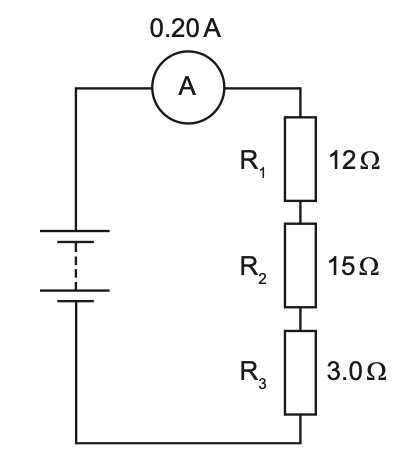
<image of a series circuit with a battery, an ammeter showing 0.20A, and three resistors: R₁ = 12Ω, R₂ = 15Ω, R₃ = 3.0Ω>
Resistor R₃ is now removed and the circuit is reconnected.
What is the new current in the circuit?
<image of a series circuit with a battery, an ammeter showing 0.20A, and three resistors: R₁ = 12Ω, R₂ = 15Ω, R₃ = 3.0Ω>
Resistor R₃ is now removed and the circuit is reconnected.
What is the new current in the circuit?
- A.0.20 A
- B.0.22 A
- C.0.33 A
- D.0.40 A
- E.0.50 A
- F.2.0 A
- G.6.0 A
Answer: B
Question 5
1 markThe line joining the points with coordinates and is parallel to the line with equation
What is the value of ?
What is the value of ?
- A.-1
- B.
- C.
- D.
- E.1
- F.
- G.2
- H.5
Answer: H
Question 6
1 markWhen travelling in a vacuum, visible light has a wavelength between 400 nm and 700 nm.
The speed of light in a vacuum is ms⁻¹.
What can be concluded about ultraviolet radiation from this information?
The speed of light in a vacuum is ms⁻¹.
What can be concluded about ultraviolet radiation from this information?
- A.It has a maximum frequency of Hz
- B.It has a maximum frequency of Hz
- C.It has a maximum frequency of Hz
- D.It has a maximum frequency of Hz
- E.It has a minimum frequency of Hz
- F.It has a minimum frequency of Hz
- G.It has a minimum frequency of Hz
- H.It has a minimum frequency of Hz
Answer: G
Question 7
1 markA rectangle PQRS is drawn inside a circle, with its vertices on the circumference of the circle.
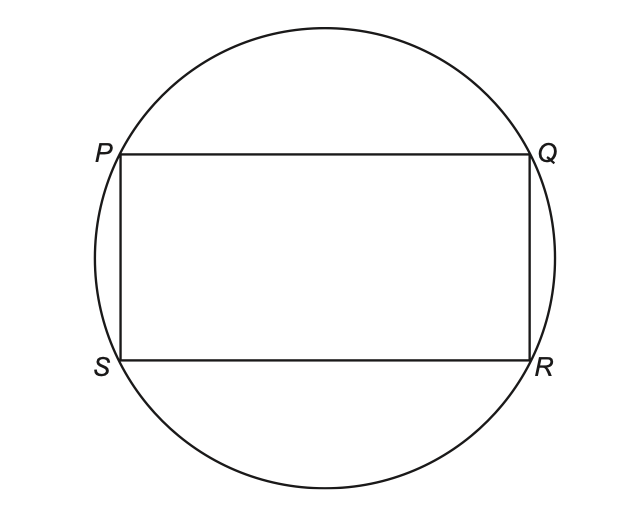
[diagram not to scale]
The ratio of the length of PQ to the length of QR is 2:1
The area of the rectangle PQRS is 96 cm².
What is the radius, in cm, of the circle?
[diagram not to scale]
The ratio of the length of PQ to the length of QR is 2:1
The area of the rectangle PQRS is 96 cm².
What is the radius, in cm, of the circle?
- A.
- B.3
- C.
- D.
- E.
- F.12
- G.
- H.
Answer: D
Question 8
1 markA filament lamp working at its operating voltage converts electrical energy at a rate of 100 W.
The lamp has an efficiency of 5.0%.
How much energy is wasted by the lamp in 10 minutes?
The lamp has an efficiency of 5.0%.
How much energy is wasted by the lamp in 10 minutes?
- A.50 J
- B.950 J
- C.1000 J
- D.3000 J
- E.57 000 J
- F.60 000 J
Answer: E
Question 9
1 mark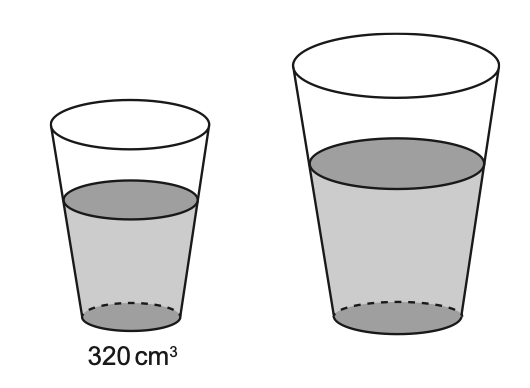
[diagram not to scale]
At a cinema, drinks are sold in regular and large sizes.
The cups for these are mathematically similar.
The ratio of the heights of the cups and the ratio of the depths of the drinks are both 4:5
The volume of drink in a regular size cup is 320 cm³.
What is the volume, in cm³, of drink in a large size cup?
- A.384
- B.400
- C.500
- D.576
- E.625
- F.640
Answer: E
Question 10
1 markThe potential difference across the motor in an electric car is 400 V and the current in the motor is 1250 A.
The car accelerates along a horizontal road from rest for 4.0 s.
The efficiency of the overall system is 45%.
What is the kinetic energy of the car at the end of the 4.0 s?
(Ignore energy losses due to air resistance and due to friction between the tyres and the road.)
The car accelerates along a horizontal road from rest for 4.0 s.
The efficiency of the overall system is 45%.
What is the kinetic energy of the car at the end of the 4.0 s?
(Ignore energy losses due to air resistance and due to friction between the tyres and the road.)
- A.225 000 J
- B.500 000 J
- C.900 000 J
- D.1 250 000 J
- E.2 000 000 J
Answer: C
Question 11
1 markThe straight lines
enclose a region with area K square units.
What is the value of K?
enclose a region with area K square units.
What is the value of K?
- A.39
- B.78
- C.99
- D.129
- E.198
- F.258
Answer: C
Question 12
1 markThe momentum of a small object moving in a straight line is 24 kgms⁻¹ and its kinetic energy is 96 J.
What is the mass of the object?
What is the mass of the object?
- A.3.0 kg
- B.4.0 kg
- C.6.0 kg
- D.8.0 kg
- E.12 kg
Answer: A
Question 13
1 markA scale model of a cylindrical pillar is to be made.
The full-sized pillar has a volume of 12 m³.
The model will use a length scale of 1:40
The model is to be a solid cylinder made of a plastic which has a density of gcm⁻³.
What is the mass of the model in grams?
The full-sized pillar has a volume of 12 m³.
The model will use a length scale of 1:40
The model is to be a solid cylinder made of a plastic which has a density of gcm⁻³.
What is the mass of the model in grams?
- A.
- B.
- C.
- D.
- E.
- F.
- G.
- H.
Answer: E
Question 14
1 markA radioactive isotope decays in a single step to a stable isotope.
A radiation detector is placed very near to a sample of the radioactive isotope in a laboratory. The count rate on the detector changes as time elapses. The graph shows how the measured count rate changes with time.
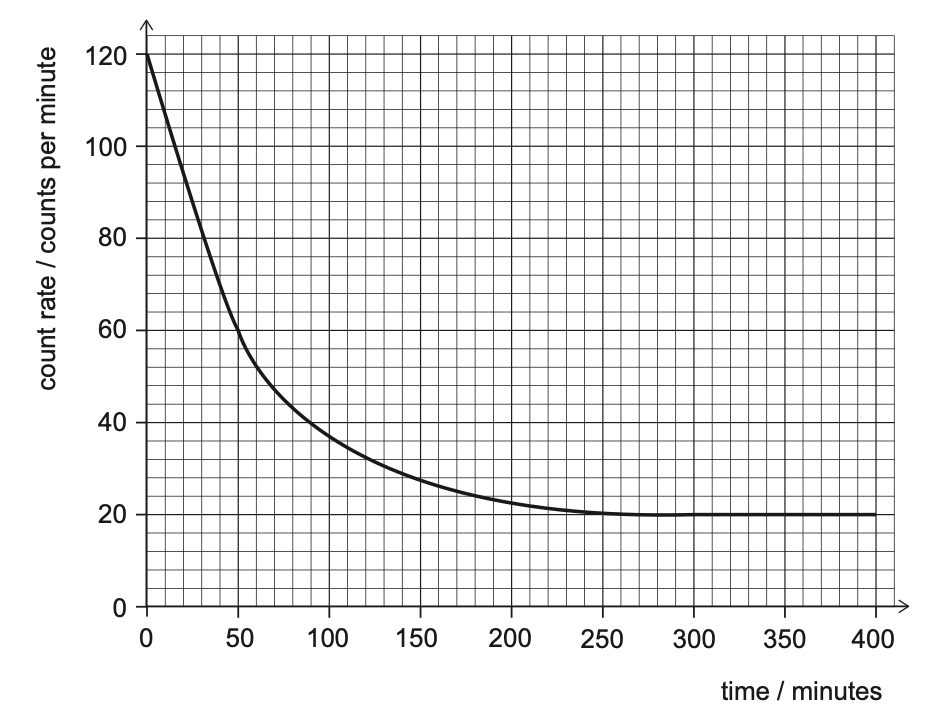
What is the background count rate and what is the half-life of the isotope?
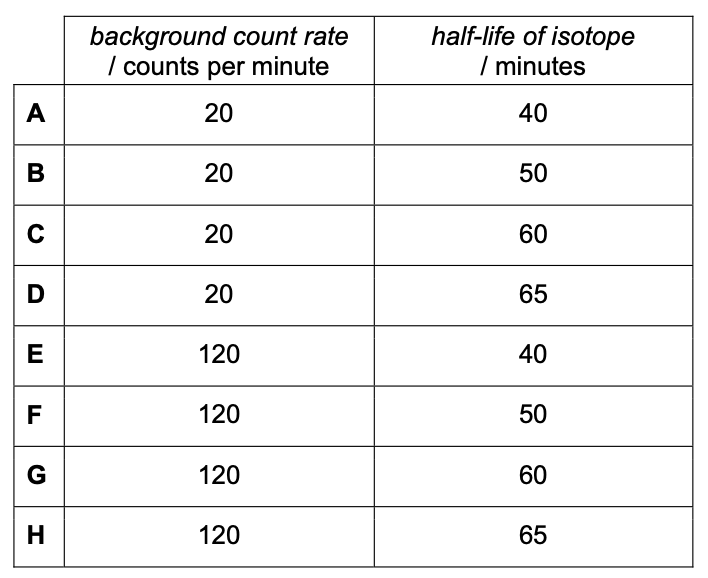
A radiation detector is placed very near to a sample of the radioactive isotope in a laboratory. The count rate on the detector changes as time elapses. The graph shows how the measured count rate changes with time.
What is the background count rate and what is the half-life of the isotope?
- A.background count rate / counts per minute: 20, half-life of isotope / minutes: 40
- B.background count rate / counts per minute: 20, half-life of isotope / minutes: 50
- C.background count rate / counts per minute: 20, half-life of isotope / minutes: 60
- D.background count rate / counts per minute: 20, half-life of isotope / minutes: 65
- E.background count rate / counts per minute: 120, half-life of isotope / minutes: 40
- F.background count rate / counts per minute: 120, half-life of isotope / minutes: 50
- G.background count rate / counts per minute: 120, half-life of isotope / minutes: 60
- H.background count rate / counts per minute: 120, half-life of isotope / minutes: 65
Answer: A
Question 15
1 mark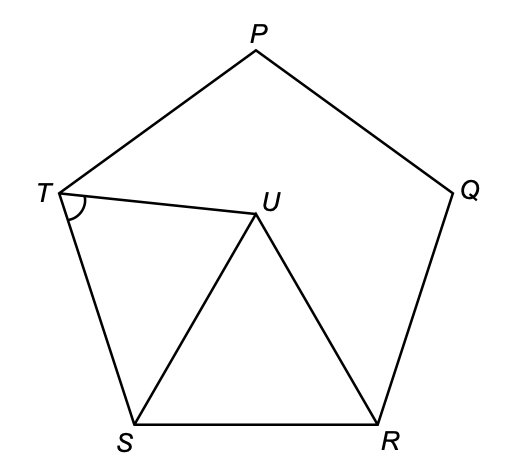
[diagram not to scale]
PQRST is a regular pentagon.
RSU is an equilateral triangle.
What is the size of angle STU?
- A.48°
- B.54°
- C.60°
- D.66°
- E.84°
Answer: D
Question 16
1 markA rock falling vertically experiences an air resistance force of 12 N at an instant when its acceleration is 2.0 ms⁻² downwards.
What is the mass of the rock?
(gravitational field strength = 10 N kg⁻¹)
What is the mass of the rock?
(gravitational field strength = 10 N kg⁻¹)
- A.1.0 kg
- B.1.2 kg
- C.1.5 kg
- D.6.0 kg
- E.10 kg
- F.12 kg
- G.15 kg
- H.60 kg
Answer: C
Question 17
1 markThe original price of an item is p
The price is increased by 125%
The increased price is then decreased by 40% to q
The relationship between p and q can be expressed as
What is the value of m?
The price is increased by 125%
The increased price is then decreased by 40% to q
The relationship between p and q can be expressed as
What is the value of m?
- A.
- B.
- C.
- D.
- E.
Answer: C
Question 18
1 markA transverse wave with an amplitude of 4.0 cm and a frequency of 10 Hz travels along a rope at a speed of 2.4 ms⁻¹.
What is the total distance travelled by a particle in the rope in a time of 20 s?
What is the total distance travelled by a particle in the rope in a time of 20 s?
- A.2.4 m
- B.4.8 m
- C.8.0 m
- D.16 m
- E.32 m
- F.48 m
Answer: E
Question 19
1 markQ is 5 km away from P on a bearing of 065°
R is 5 km away from Q on a bearing of 155°
What is the bearing of P from R?
R is 5 km away from Q on a bearing of 155°
What is the bearing of P from R?
- A.070°
- B.110°
- C.225°
- D.270°
- E.290°
- F.315°
- G.335°
Answer: E
Question 20
1 markA student places a measuring cylinder on a balance. She pours a volume V of water into the measuring cylinder, and finds that the mass of the measuring cylinder and water together is 290 g.
She then empties the measuring cylinder and dries it before putting it back on the balance.
She now pours the same volume V of olive oil into the measuring cylinder, and finds that the mass of the measuring cylinder and olive oil together is 270 g.
What is the mass of the measuring cylinder?
(densities: olive oil = 0.90 g cm⁻³; water = 1.0 g cm⁻³)
She then empties the measuring cylinder and dries it before putting it back on the balance.
She now pours the same volume V of olive oil into the measuring cylinder, and finds that the mass of the measuring cylinder and olive oil together is 270 g.
What is the mass of the measuring cylinder?
(densities: olive oil = 0.90 g cm⁻³; water = 1.0 g cm⁻³)
- A.18 g
- B.20 g
- C.90 g
- D.180 g
- E.200 g
Answer: C
Question 21
1 mark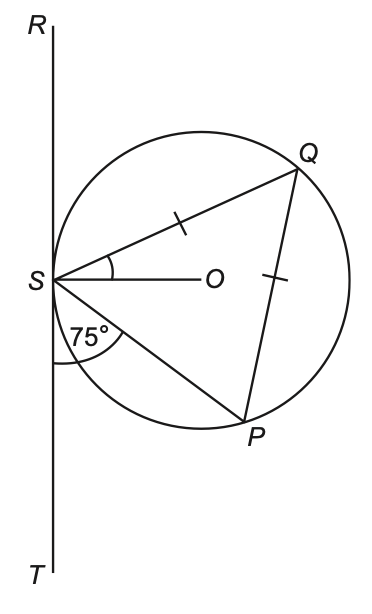
[diagram not to scale]
The line segment RT is a tangent at the point S to a circle with centre O
Q and P are points on the circumference of the circle such that QS = QP
Angle PST = 75°
What is the size of angle QSO?
- A.15°
- B.30°
- C.37.5°
- D.45°
- E.52.5°
- F.60°
- G.67.5°
- H.75°
Answer: C
Question 22
1 markA skydiver of weight 1000 N falls vertically.
The distance-time graph for the skydiver is shown below.
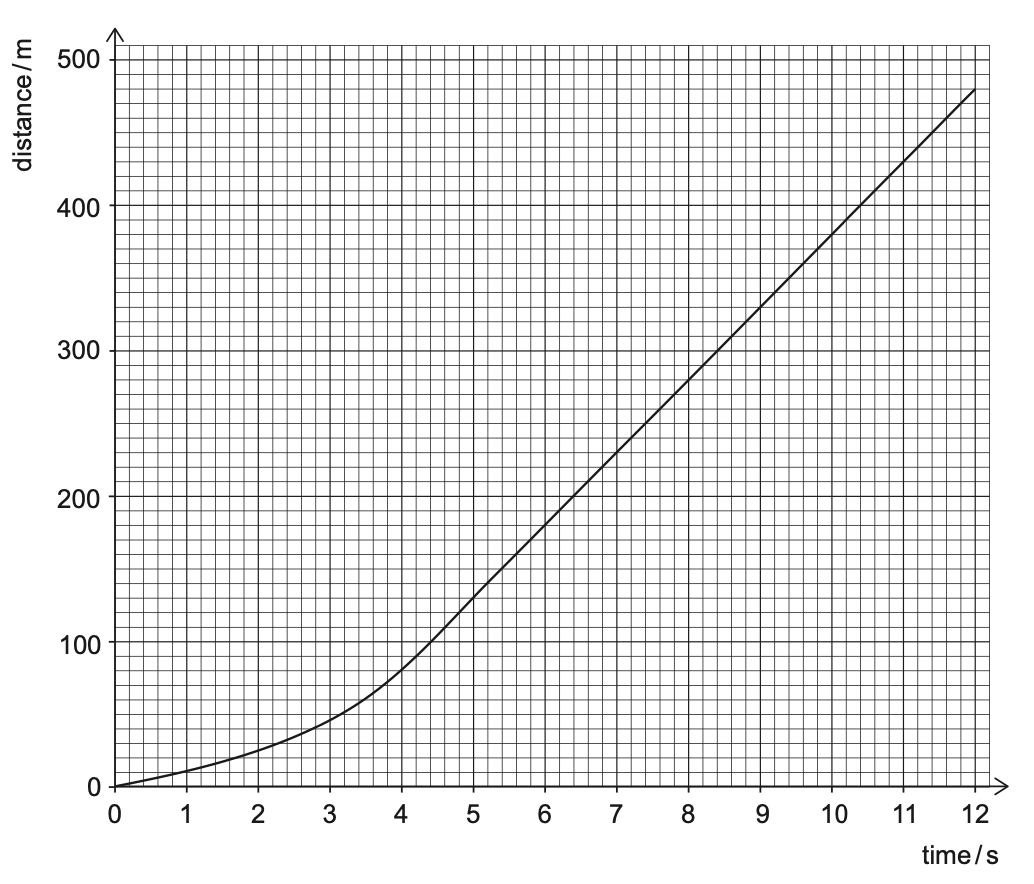
The air resistance F (in N) acting on the skydiver travelling at velocity v (in ms⁻¹) is given by the equation
where k (in Nm⁻²s²) is a constant.
What is the numerical value of k for the skydiver?
The distance-time graph for the skydiver is shown below.
The air resistance F (in N) acting on the skydiver travelling at velocity v (in ms⁻¹) is given by the equation
where k (in Nm⁻²s²) is a constant.
What is the numerical value of k for the skydiver?
- A.0.050
- B.0.40
- C.0.63
- D.2.5
- E.20
Answer: B
Question 23
1 mark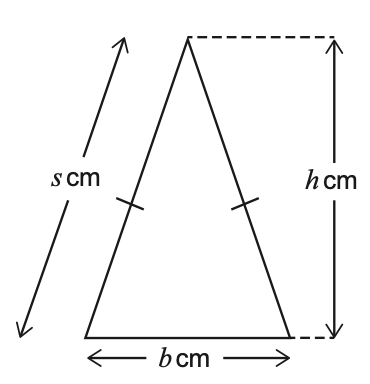
[diagram not to scale]
The vertical height h cm of an isosceles triangle is 3 cm longer than the base length of b cm.
The sloping side is of length s cm.
The area of the triangle is 14 cm².
There is one value of s which satisfies these conditions.
Within which range does this value of s lie?
- A.
- B.
- C.
- D.
- E.
- F.
Answer: C
Question 24
1 markA neutron is absorbed by a uranium-235 (U) nuclide.
The resulting nuclide undergoes fission to produce a bromine-88 (Br) nuclide, a lanthanum-145 nuclide and some neutrons.
The lanthanum-145 nuclide is radioactive and emits a beta () particle.
How many neutrons are emitted in the fission reaction and how many protons are there in the nuclide formed by the decay of lanthanum-145?
The resulting nuclide undergoes fission to produce a bromine-88 (Br) nuclide, a lanthanum-145 nuclide and some neutrons.
The lanthanum-145 nuclide is radioactive and emits a beta () particle.
How many neutrons are emitted in the fission reaction and how many protons are there in the nuclide formed by the decay of lanthanum-145?
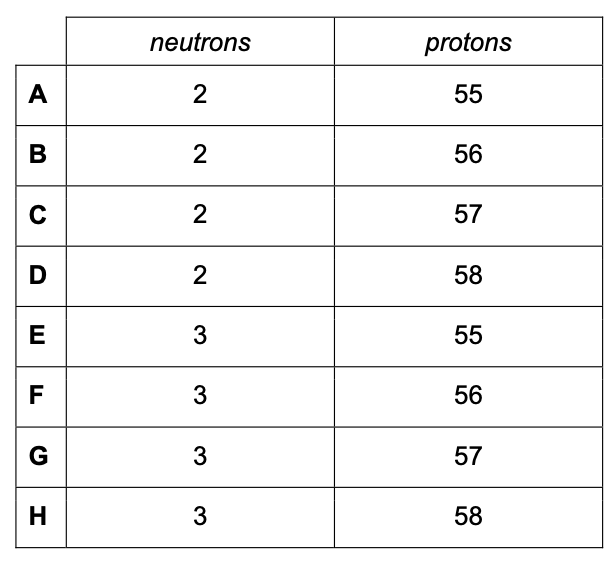
- A.neutrons: 2, protons: 55
- B.neutrons: 2, protons: 56
- C.neutrons: 2, protons: 57
- D.neutrons: 2, protons: 58
- E.neutrons: 3, protons: 55
- F.neutrons: 3, protons: 56
- G.neutrons: 3, protons: 57
- H.neutrons: 3, protons: 58
Answer: H
Question 25
1 markThe first five terms of a sequence in order are:
2 17 42 77 122
The nᵗʰ term of this sequence is where p and q are integers.
What is the value of ?
2 17 42 77 122
The nᵗʰ term of this sequence is where p and q are integers.
What is the value of ?
- A.
- B.
- C.1
- D.
- E.
- F.2
- G.4
- H.14
Answer: G
Question 26
1 markThe diagram shows a circuit containing a battery and three identical resistors X, Y and Z.
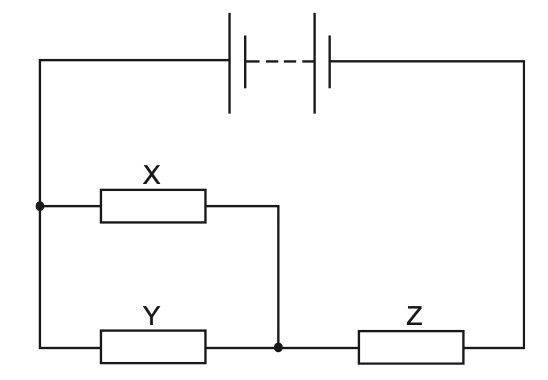
The total power supplied by the battery is 18 W.
What is the power dissipated as heat in resistor X?
The total power supplied by the battery is 18 W.
What is the power dissipated as heat in resistor X?
- A.1.5 W
- B.2.0 W
- C.3.0 W
- D.4.5 W
- E.6.0 W
- F.8.0 W
- G.12 W
Answer: C
Question 27
1 markA bag contains 6 red and 6 green sweets. The sweets are identical apart from their colour.
A child takes a sweet at random from the bag.
If the sweet is red, the child stops taking sweets.
If the sweet is green, it is not replaced and the child takes another sweet.
This continues until a red sweet is taken at which point the child stops taking sweets.
What is the probability that the child takes more green sweets than red sweets?
A child takes a sweet at random from the bag.
If the sweet is red, the child stops taking sweets.
If the sweet is green, it is not replaced and the child takes another sweet.
This continues until a red sweet is taken at which point the child stops taking sweets.
What is the probability that the child takes more green sweets than red sweets?
- A.
- B.
- C.
- D.
- E.
- F.
Answer: B
Question 28
1 markThree detectors X, Y and Z are separated by large distances.
Each of the detectors records a seismic wave from the same earthquake whose epicentre (source) is very close to the surface of the Earth.
The wave travels out from the epicentre at 4.0 kms⁻¹.
Detectors X and Y start to detect the wave at the same time, but detector Z starts to detect it one minute later.
Which of the following statements must be correct?
1 The epicentre is at the midpoint of the line XY.
2 Z is equidistant from X and Y.
3 Z is no more than 240 km away from X and from Y.
Each of the detectors records a seismic wave from the same earthquake whose epicentre (source) is very close to the surface of the Earth.
The wave travels out from the epicentre at 4.0 kms⁻¹.
Detectors X and Y start to detect the wave at the same time, but detector Z starts to detect it one minute later.
Which of the following statements must be correct?
1 The epicentre is at the midpoint of the line XY.
2 Z is equidistant from X and Y.
3 Z is no more than 240 km away from X and from Y.
- A.none of them
- B.1 only
- C.2 only
- D.3 only
- E.1 and 2 only
- F.1 and 3 only
- G.2 and 3 only
- H.1, 2 and 3
Answer: A
Question 29
1 markCurve C has equation
Line L has equation
What is the area enclosed between C and L?
Line L has equation
What is the area enclosed between C and L?
- A.
- B.
- C.
- D.
- E.
Answer: A
Question 30
1 markAn aircraft moves from rest with uniform acceleration along a horizontal runway. After travelling 1600 m it reaches a speed of 80 m s⁻¹.
What is the acceleration of the aircraft?
What is the acceleration of the aircraft?
- A.
- B.
- C.
- D.
- E.
- F.
- G.
- H.
Answer: E
Question 31
1 markHow many solutions of the equation lie in the interval ?
- A.2
- B.3
- C.4
- D.5
- E.6
- F.7
Answer: D
Question 32
1 markThe diagram represents a mass that is moving in a straight line at constant speed up a slope of constant gradient.
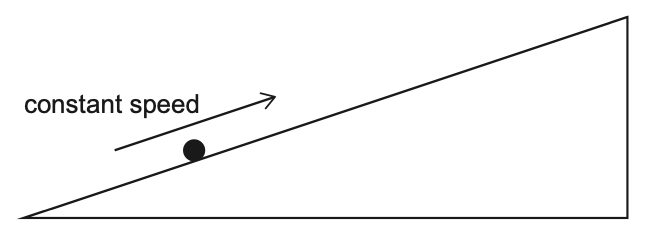
Which statement about the forces acting on the mass must be correct?
Which statement about the forces acting on the mass must be correct?
- A.All the forces acting on the mass are equal in magnitude.
- B.Only three forces act on the mass.
- C.The force of friction on the mass is equal to the driving force.
- D.The weight of the mass acts in the opposite direction to the contact force.
- E.There is no air resistance acting on the mass.
- F.There is no resultant force acting on the mass.
Answer: F
Question 33
1 markThe line , where k is a constant, is a tangent to the curve
What is the value of k?
What is the value of k?
- A.-2
- B.-1
- C.
- D.
- E.
- F.
- G.1
- H.2
Answer: C
Question 34
1 markThe diagram shows four objects W, X, Y and Z, of masses 3.0 kg, 4.0 kg, 6.0 kg and 2.0 kg respectively, connected by light, inextensible rods.
The objects are pulled along a smooth, horizontal surface by a constant force of 30 N in the direction indicated.

What is the tension in the rod connecting X and Y?
The objects are pulled along a smooth, horizontal surface by a constant force of 30 N in the direction indicated.
What is the tension in the rod connecting X and Y?
- A.8.0 N
- B.10 N
- C.12 N
- D.14 N
- E.16 N
Answer: D
Question 35
1 markA sector S of a circle has area cm².
The angle of sector S is increased by radians to form sector T.
The total area of sector T is cm².
What is the total arc length, in cm, of sector T?
The angle of sector S is increased by radians to form sector T.
The total area of sector T is cm².
What is the total arc length, in cm, of sector T?
- A.
- B.
- C.
- D.
Answer: D
Question 36
1 markAn object of mass 40 kg is placed on a uniform, horizontal plank of mass 10 kg between two supports X and Y as shown in the diagram.
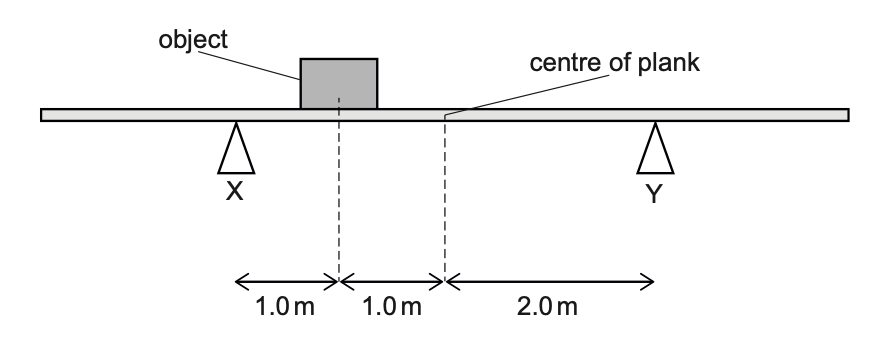
What is the contact force at X?
(gravitational field strength = 10 Nkg⁻¹)
What is the contact force at X?
(gravitational field strength = 10 Nkg⁻¹)
- A.15 N
- B.35 N
- C.150 N
- D.250 N
- E.300 N
- F.350 N
- G.375 N
Answer: F
Question 37
1 markIn a particular arithmetic progression:
• the 13ᵗʰ term is six times the 1ˢᵗ term
• the 11ᵗʰ term is 1 less than twice the 5ᵗʰ term
What is the 3ʳᵈ term of the progression?
• the 13ᵗʰ term is six times the 1ˢᵗ term
• the 11ᵗʰ term is 1 less than twice the 5ᵗʰ term
What is the 3ʳᵈ term of the progression?
- A.-14.5
- B.-11
- C.
- D.3.5
- E.11
- F.14.5
Answer: E
Question 38
1 markA block of mass m slides a distance l down a slope that is inclined at angle to the horizontal, as shown:
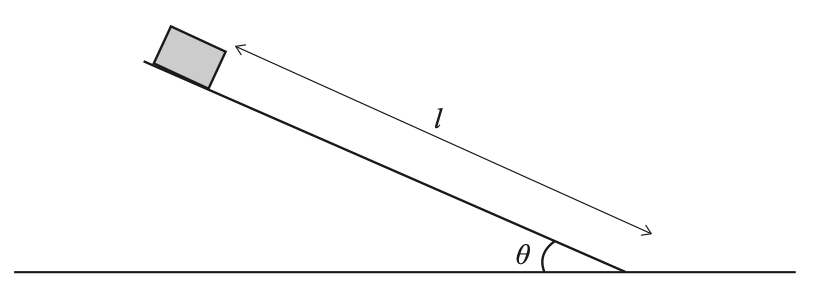
The block experiences a friction force of , where W is the weight of the block and k is a constant.
The block starts from rest at the top of the slope and slides down a distance l to the bottom, where its potential energy is zero.
What fraction of the initial potential energy at the top has become kinetic energy as the block reaches the bottom?
The block experiences a friction force of , where W is the weight of the block and k is a constant.
The block starts from rest at the top of the slope and slides down a distance l to the bottom, where its potential energy is zero.
What fraction of the initial potential energy at the top has become kinetic energy as the block reaches the bottom?
- A.k
- B.1 – k
- C.
- D.
- E.
- F.
Answer: B
Question 39
1 markThe first three terms of a geometric progression, whose terms are all greater than zero, are , and
What is the fifth term of the progression?
What is the fifth term of the progression?
- A.324
- B.486
- C.1250
- D.1458
- E.3888
Answer: B
Question 40
1 markAn object X of mass 2.0 kg is initially moving at a speed of 4.5 m s⁻¹ on a smooth, horizontal surface.
A 5.0 N force is applied to X in the direction of its motion for 3.0 seconds.
A short time later it collides head on with, and sticks to, a stationary object Y of mass 3.0 kg.
What is the speed of X and Y as they move off together after the collision?
A 5.0 N force is applied to X in the direction of its motion for 3.0 seconds.
A short time later it collides head on with, and sticks to, a stationary object Y of mass 3.0 kg.
What is the speed of X and Y as they move off together after the collision?
- A.1.8 ms⁻¹
- B.3.0 ms⁻¹
- C.3.6 ms⁻¹
- D.4.8 ms⁻¹
- E.5.4 ms⁻¹
Answer: D
Question 41
1 markEvaluate
- A.-2
- B.3
- C.4
- D.6
- E.
- F.
Answer: C
Question 42
1 markA ball of mass 0.20 kg is thrown vertically downwards at an initial speed of 4.0 ms⁻¹ and travels a distance of 0.45 m to the ground.
The ball hits the ground, and rebounds with an initial speed of 2.0 ms⁻¹.
How much energy does the ball lose in the bounce?
(gravitational field strength = 10 Nkg⁻¹; air resistance can be ignored)
The ball hits the ground, and rebounds with an initial speed of 2.0 ms⁻¹.
How much energy does the ball lose in the bounce?
(gravitational field strength = 10 Nkg⁻¹; air resistance can be ignored)
- A.0.10 J
- B.0.40 J
- C.0.50 J
- D.0.90 J
- E.1.2 J
- F.1.6 J
- G.2.1 J
Answer: G
Question 43
1 markCircle C has equation
The length of the tangent from the circle C to the point P is
What is the shortest distance from P to C?
The length of the tangent from the circle C to the point P is
What is the shortest distance from P to C?
- A.
- B.
- C.
- D.5
- E.10
Answer: C
Question 44
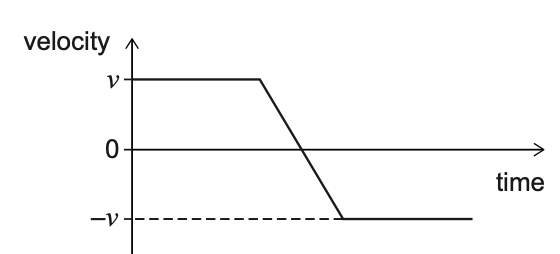
1 markTwo solid spheres X and Y have masses m and 2m respectively. They travel in opposite directions towards each other along the same line with speeds v and 2v respectively and collide head on.
The graph shows the variation of velocity with time for sphere X before, during, and after the collision.
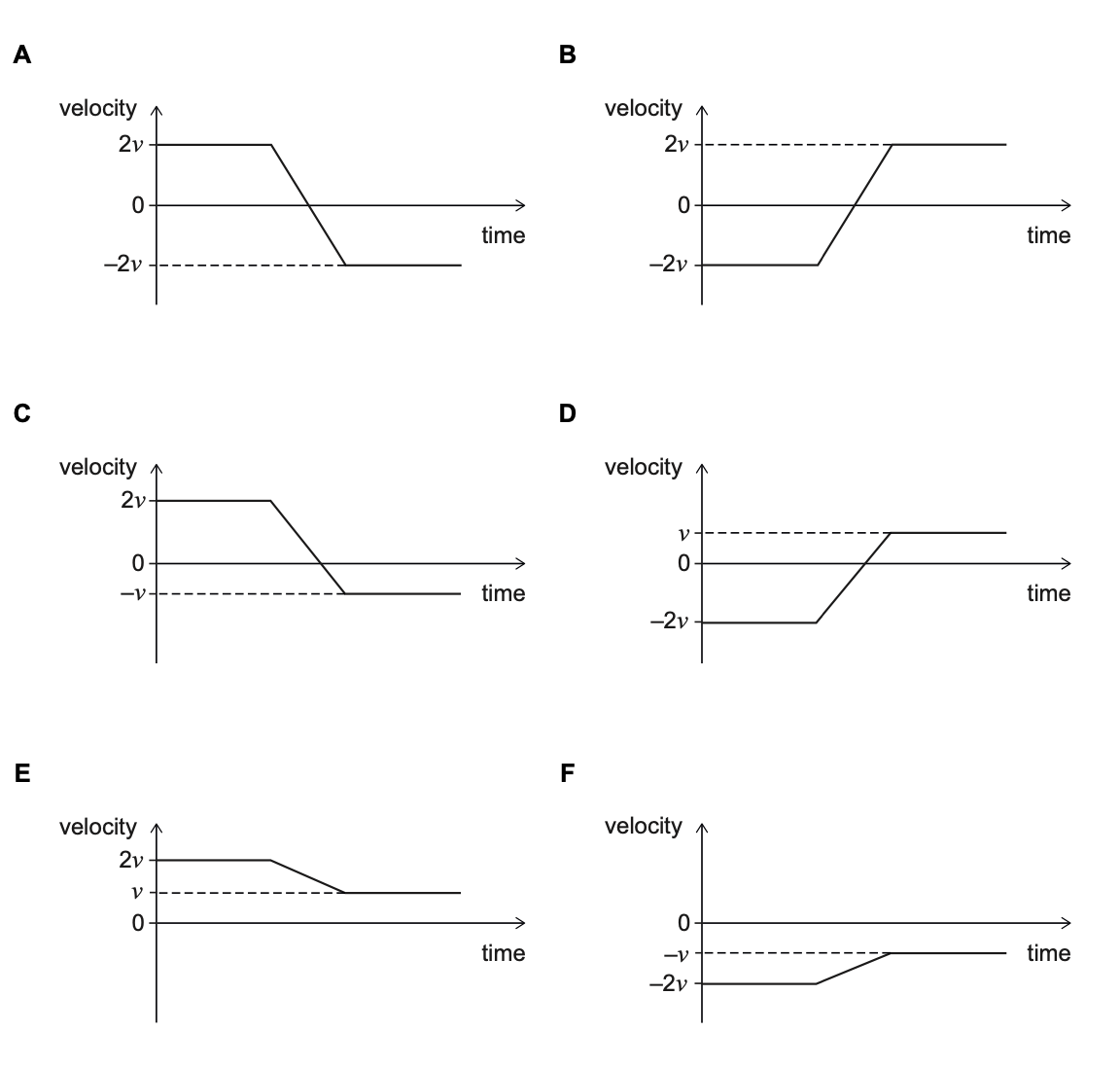
Which sketch shows the variation of velocity with time for sphere Y?
The graph shows the variation of velocity with time for sphere X before, during, and after the collision.
Which sketch shows the variation of velocity with time for sphere Y?
- A.Option A
- B.Option B
- C.Option C
- D.Option D
- E.Option E
- F.Option F
Answer: F
Question 45
1 markThe points A (−3, 2), B (1, 3) and C (−1, u) are such that the distances AC and AB are related by:
What are the possible values of u?
What are the possible values of u?
- A.2 and -6
- B.-2 and 6
- C.6 and -10
- D.-6 and 10
- E. and
- F. and
Answer: D
Question 46
1 markA metal ball suspended from a steel cable is held at rest by a horizontal force P. The cable makes an angle of 30° to the vertical as shown in the diagram. The cable exerts a force T on the ball.
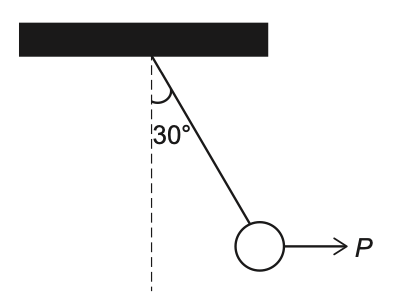
What is the magnitude of P?
What is the magnitude of P?
- A.
- B.T
- C.2T
- D.
- E.
- F.
- G.
Answer: A
Question 47
1 markWhat is the coefficient of in the expansion of ?
- A.-6400
- B.-640
- C.-80
- D.0
- E.80
- F.800
- G.960
Answer: D
Question 48
1 markA pendulum bob of mass 10 g is suspended by a light, inextensible string of length 50 cm.
The bob is released from rest at position X.
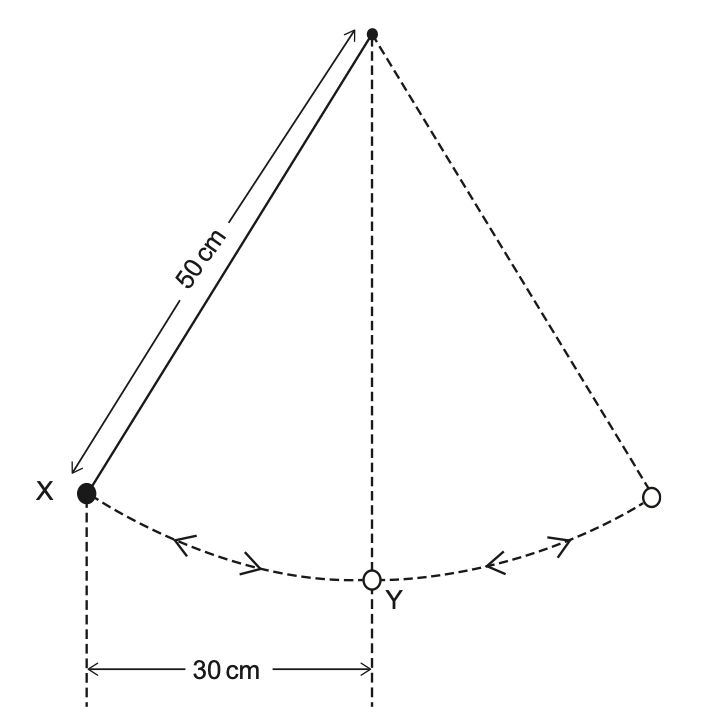
What is the speed of the bob as it passes through position Y?
(gravitational field strength g = 10 N kg⁻¹; assume that resistive forces are negligible)
The bob is released from rest at position X.
What is the speed of the bob as it passes through position Y?
(gravitational field strength g = 10 N kg⁻¹; assume that resistive forces are negligible)
- A. ms⁻¹
- B. ms⁻¹
- C. ms⁻¹
- D. ms⁻¹
- E. ms⁻¹
Answer: A
Question 49
1 markGiven that
and
what is the value of m?
and
what is the value of m?
- A.
- B.
- C.
- D.
- E.
- F.
Answer: E
Question 50
1 markAn object of mass m is initially moving at constant speed u to the right. It collides with a stationary object of greater mass M and bounces back in the opposite direction at speed v.
What is the speed of the greater mass immediately after the collision?
What is the speed of the greater mass immediately after the collision?
- A.
- B.
- C.
- D.
- E.
- F.
Answer: E
Question 51
1 markThe two functions f and g satisfy
where a is a constant.
Given that
and
what is the value of a?
where a is a constant.
Given that
and
what is the value of a?
- A.1
- B.3
- C.5
- D.6
- E.15
Answer: A
Question 52
1 markA load drops from rest through a vertical height h to the ground.
A light cable attached to the load passes over a friction pulley that provides a braking force during the fall.
As the load falls through height h, 50% of the gravitational potential energy lost is transferred into thermal energy.
The load reaches a final speed of 10 ms⁻¹.
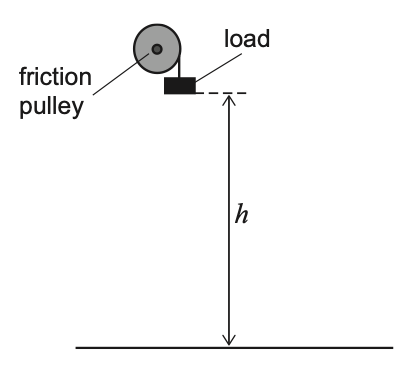
What is the vertical height h?
(gravitational field strength g = 10 N kg⁻¹; air resistance can be ignored)
A light cable attached to the load passes over a friction pulley that provides a braking force during the fall.
As the load falls through height h, 50% of the gravitational potential energy lost is transferred into thermal energy.
The load reaches a final speed of 10 ms⁻¹.
What is the vertical height h?
(gravitational field strength g = 10 N kg⁻¹; air resistance can be ignored)
- A.0.50 m
- B.1.0 m
- C.2.0 m
- D.2.5 m
- E.5.0 m
- F.10 m
- G.20 m
Answer: F
Question 53
1 markThe dimensions of a solid cuboid, in cm, are x, 2x and y
The volume of the cuboid is 576 cm³.
At this volume, the surface area of the cuboid has its maximum value.
What is the area, in cm², of the face that has the largest area?
The volume of the cuboid is 576 cm³.
At this volume, the surface area of the cuboid has its maximum value.
What is the area, in cm², of the face that has the largest area?
- A.
- B.72
- C.96
- D.432
- E.
Answer: C
Question 54
1 markAn object is thrown vertically upwards from ground level with an initial velocity of 40 m s⁻¹.
2.0 seconds later another object is released from a height above the ground and falls vertically from rest.
Both of the objects hit the ground at the same time.
From what height above the ground was the second object released?
(gravitational field strength g = 10 N kg⁻¹; air resistance can be ignored)
2.0 seconds later another object is released from a height above the ground and falls vertically from rest.
Both of the objects hit the ground at the same time.
From what height above the ground was the second object released?
(gravitational field strength g = 10 N kg⁻¹; air resistance can be ignored)
- A.80 m
- B.180 m
- C.320 m
- D.500 m
- E.900 m
Answer: B