NSAA 2017 Advanced Mathematics And Advanced Physics S1
18 questions18 marksUpdated June 2026
The NSAA 2017 Advanced Mathematics And Advanced Physics S1 paper in full: all 18 questions, each with its answer. NSAA is the Natural Sciences Admissions Assessment. Sit it cold under exam timing, mark it, then work back through anything you missed using the solutions below.
Download the original PDF →Questions and answers are free. Full step-by-step worked solutions unlock with a free account. Start practising.
Question 73
1 markWhich one of the following is a simplification of
- A.
- B.
- C.
- D.
- E.
- F.
- G.
- H.
Answer: E
Question 74
1 markThe diagram shows a crane being used on a building site. The crane is perfectly balanced about P.
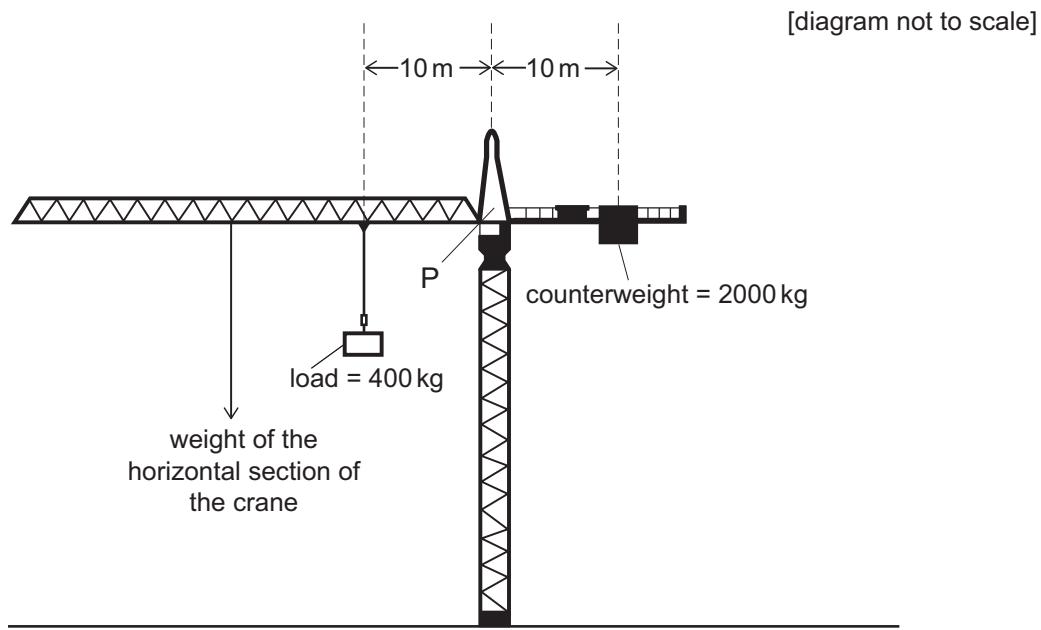
The load is now moved to the left by 5.0 m.
To keep the crane perfectly balanced about P, how far does the counterweight have to move, and in which direction?
(gravitational field strength = )
The load is now moved to the left by 5.0 m.
To keep the crane perfectly balanced about P, how far does the counterweight have to move, and in which direction?
(gravitational field strength = )
- A.1.0 m to the left
- B.1.0 m to the right
- C.3.0 m to the left
- D.3.0 m to the right
- E.4.0 m to the left
- F.4.0 m to the right
Answer: B
Question 75
1 mark is the smallest positive value of which is a solution to **both** the equations and
How many values of in the range are solutions to at least one of these equations?
How many values of in the range are solutions to at least one of these equations?
- A.0
- B.2
- C.3
- D.4
- E.8
Answer: C
Question 76
1 markAn aircraft is climbing at constant speed in a straight line at an angle of 10° to the horizontal.
Which statement about the resultant force on the aircraft is correct?
Which statement about the resultant force on the aircraft is correct?
- A.It is parallel to its motion.
- B.It is perpendicular to its motion.
- C.It is zero.
- D.It is equal to its weight.
- E.It is equal to the drag acting on the aircraft.
Answer: C
Question 77
1 markWhich of the following is a solution to the equation ?
- A.
- B.
- C.2
- D.
- E.
Answer: B
Question 78
1 markA ball starts at a speed of . The ball is subject to a constant deceleration of as it travels a distance of in a straight line.
What is the final speed of the ball?
What is the final speed of the ball?
- A.
- B.
- C.
- D.
- E.
- F.
Answer: D
Question 79
1 markThe graph of the function , where and are real constants, has a local maximum when and a local minimum when .
What are the values of and ?
What are the values of and ?
- A. and
- B. and
- C. and
- D. and
- E. and
- F. and
Answer: D
Question 80
1 markA block of mass 1.0 kg is at rest on a rough horizontal surface. The block is attached by a light inextensible string to a force meter. The other end of the force meter is attached by another light inextensible string via a frictionless pulley to a load of mass 1.0 kg. The block remains stationary.
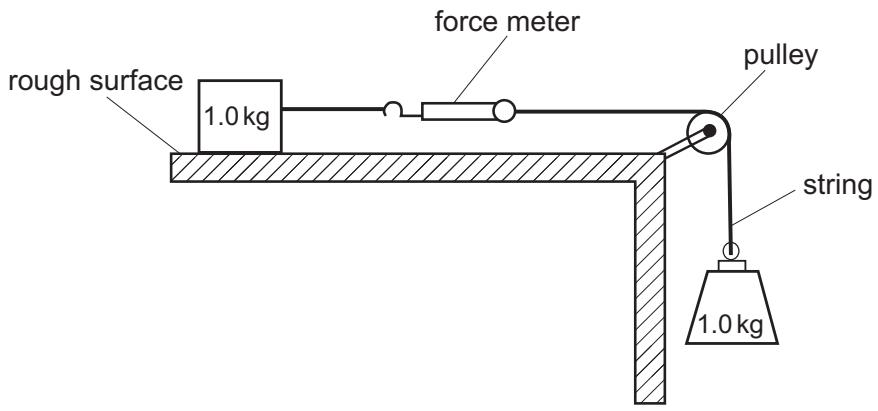
What is the reading on the force meter?
(gravitational field strength = )
What is the reading on the force meter?
(gravitational field strength = )
- A.0.0 N
- B.0.5 N
- C.1.0 N
- D.2.0 N
- E.5.0 N
- F.10 N
- G.20 N
Answer: F
Question 81
1 markGiven that , what is the coefficient of in ?
- A.240
- B.4320
- C.4860
- D.12960
- E.19440
Answer: E
Question 82
1 markAn apple of mass 100 g, growing on a tree, falls vertically from a height of 4.0 m above the ground. It hits the ground with a speed of .
How much work does the apple do against resistive forces during its descent, before it hits the ground?
(gravitational field strength = )
How much work does the apple do against resistive forces during its descent, before it hits the ground?
(gravitational field strength = )
- A.0.80 J
- B.3.6 J
- C.4.0 J
- D.7.2 J
- E.8.0 J
Answer: A
Question 83
1 markA geometric progression has first term equal to 1 and common ratio .
The sum to infinity of the series is .
Find the possible values of in the range .
The sum to infinity of the series is .
Find the possible values of in the range .
- A.
- B.
- C.
- D.
- E.there are no values of x in this range
Answer: A
Question 84
1 markA stone is fired vertically upwards at a speed of on a still day from the top of a high cliff. It then falls down and lands at the bottom of the cliff.
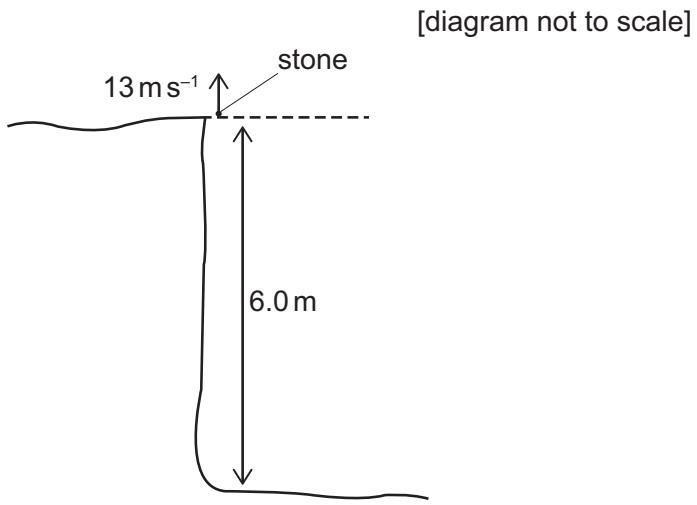
From when the stone passes the top of the cliff on the way down, how long does it take to reach the ground at the bottom of the cliff?
(air resistance can be ignored; gravitational field strength = )
From when the stone passes the top of the cliff on the way down, how long does it take to reach the ground at the bottom of the cliff?
(air resistance can be ignored; gravitational field strength = )
- A.0.40 s
- B.
- C.0.60 s
- D.
- E.1.3 s
- F.2.0 s
- G.2.5 s
- H.3.0 s
Answer: A
Question 85
1 markThe sequence of numbers is given by
where is an integer.
The fourth term, , is equal to -7.
What is the value of ?
where is an integer.
The fourth term, , is equal to -7.
What is the value of ?
- A.-10
- B.-2
- C.-1
- D.8
- E.26
Answer: C
Question 86
1 markAn archer fires an arrow of mass 0.024 kg vertically upwards from a bow.
The graph shows how the force of the bowstring on the arrow varies with distance as the arrow moves upwards.
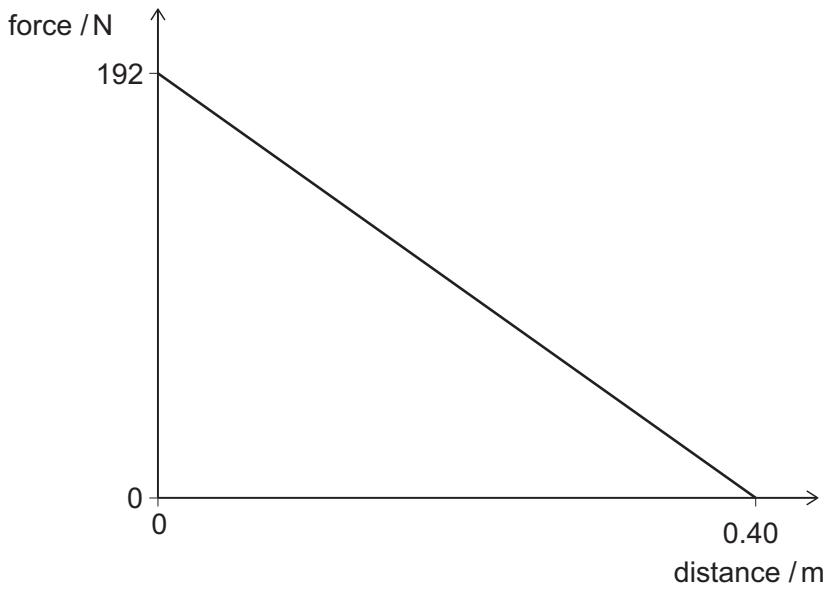
The work done by the force of the bowstring is given by the area under the force-distance graph.
When the arrow leaves the bow, what is the kinetic energy of the arrow, and what is the maximum height that it gains from this point?
(Air resistance can be ignored. The effect of gravity as the arrow is fired is negligible compared to the force of the bowstring. The gravitational field strength = .)
The graph shows how the force of the bowstring on the arrow varies with distance as the arrow moves upwards.
The work done by the force of the bowstring is given by the area under the force-distance graph.
When the arrow leaves the bow, what is the kinetic energy of the arrow, and what is the maximum height that it gains from this point?
(Air resistance can be ignored. The effect of gravity as the arrow is fired is negligible compared to the force of the bowstring. The gravitational field strength = .)
- A.kinetic energy / J: 38.4, height / m: 16
- B.kinetic energy / J: 38.4, height / m: 160
- C.kinetic energy / J: 38.4, height / m: 1600
- D.kinetic energy / J: 38.4, height / m: 16000
- E.kinetic energy / J: 76.8, height / m: 32
- F.kinetic energy / J: 76.8, height / m: 320
- G.kinetic energy / J: 76.8, height / m: 3200
- H.kinetic energy / J: 76.8, height / m: 32000
Answer: B
Question 87
1 markFind the complete set of values of for which
- A.
- B.
- C.
- D.
- E.
- F.
Answer: A
Question 88
1 markA book of mass rests on a rough horizontal surface. The surface is now tilted as shown:
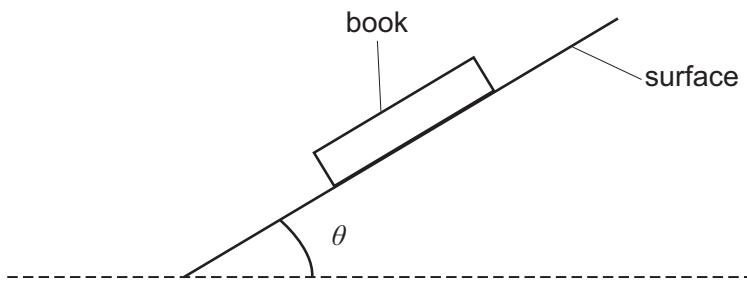
When the angle of tilt is 20°, the book slides down the slope at a constant speed.
What is the acceleration of the book down the slope when the angle of tilt is 25°?
(gravitational field strength = )
When the angle of tilt is 20°, the book slides down the slope at a constant speed.
What is the acceleration of the book down the slope when the angle of tilt is 25°?
(gravitational field strength = )
- A.
- B.
- C.
- D.
- E.
- F.
- G.
- H.
Answer: H
Question 89
1 markThe equations of two straight lines are and , where is a real constant.
For certain values of , the two lines are perpendicular.
Which of the following numbers is closest to the greatest such value of ?
For certain values of , the two lines are perpendicular.
Which of the following numbers is closest to the greatest such value of ?
- A.2.00
- B.1.75
- C.1.50
- D.1.00
- E.-0.25
- F.-0.50
Answer: B
Question 90
1 markThe graph shows how the horizontal force on a tennis ball of mass varies during a shot in a tennis match. The ball is initially travelling horizontally toward the racket with speed and leaves the racket horizontally travelling in the opposite direction with speed .
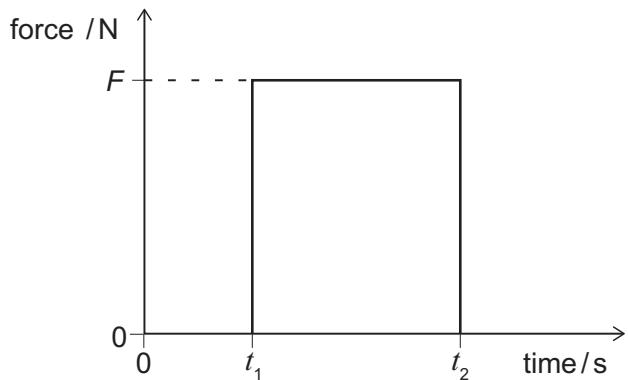
Which expression gives the magnitude of the momentum of the ball as it leaves the racket?
Which expression gives the magnitude of the momentum of the ball as it leaves the racket?
- A.
- B.
- C.
- D.
- E.
Answer: B