NSAA 2018 Advanced Mathematics And Advanced Physics PART E
18 questions18 marksUpdated June 2026
The NSAA 2018 Advanced Mathematics And Advanced Physics PART E paper in full: all 18 questions, each with its answer. NSAA is the Natural Sciences Admissions Assessment. Sit it cold under exam timing, mark it, then work back through anything you missed using the solutions below.
Download the original PDF →Questions and answers are free. Full step-by-step worked solutions unlock with a free account. Start practising.
Question 73
1 markCurve C has equation
Line L has equation
What is the area enclosed between C and L?
Line L has equation
What is the area enclosed between C and L?
- A.
- B.
- C.
- D.
- E.
Answer: A
Question 74
1 markAn aircraft moves from rest with uniform acceleration along a horizontal runway. After travelling 1600 m it reaches a speed of .
What is the acceleration of the aircraft?
What is the acceleration of the aircraft?
- A.
- B.
- C.
- D.
- E.
- F.
- G.
- H.
Answer: E
Question 75
1 markHow many solutions of the equation lie in the interval ?
- A.2
- B.3
- C.4
- D.5
- E.6
- F.7
Answer: D
Question 76
1 markThe diagram represents a mass that is moving in a straight line at constant speed up a slope of constant gradient.
Which statement about the forces acting on the mass must be correct?
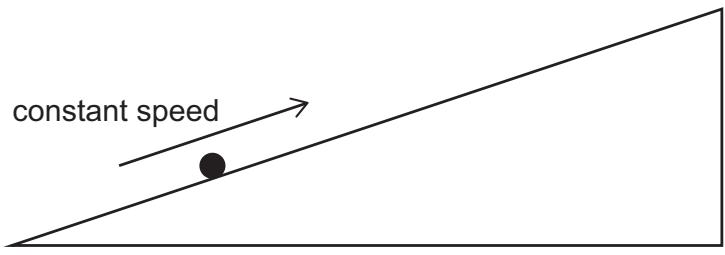
Which statement about the forces acting on the mass must be correct?
- A.All the forces acting on the mass are equal in magnitude.
- B.Only three forces act on the mass.
- C.The force of friction on the mass is equal to the driving force.
- D.The weight of the mass acts in the opposite direction to the contact force.
- E.There is no air resistance acting on the mass.
- F.There is no resultant force acting on the mass.
Answer: F
Question 77
1 markThe line , where is a constant, is a tangent to the curve
What is the value of ?
What is the value of ?
- A.-2
- B.-1
- C.
- D.
- E.
- F.
- G.1
- H.2
Answer: C
Question 78
1 markThe diagram shows four objects W, X, Y and Z, of masses 3.0 kg, 4.0 kg, 6.0 kg and 2.0 kg respectively, connected by light, inextensible rods.
The objects are pulled along a smooth, horizontal surface by a constant force of 30 N in the direction indicated.
What is the tension in the rod connecting X and Y?

The objects are pulled along a smooth, horizontal surface by a constant force of 30 N in the direction indicated.
What is the tension in the rod connecting X and Y?
- A.8.0 N
- B.10 N
- C.12 N
- D.14 N
- E.16 N
Answer: D
Question 79
1 markIn a particular arithmetic progression:
• the 13th term is six times the 1st term
• the 11th term is 1 less than twice the 5th term
What is the 3rd term of the progression?
• the 13th term is six times the 1st term
• the 11th term is 1 less than twice the 5th term
What is the 3rd term of the progression?
- A.-14.5
- B.-11
- C.
- D.3.5
- E.11
- F.14.5
Answer: E
Question 80
1 markAn object of mass 40 kg is placed on a uniform, horizontal plank of mass 10 kg between two supports X and Y as shown in the diagram.
What is the contact force at X?
(gravitational field strength = )
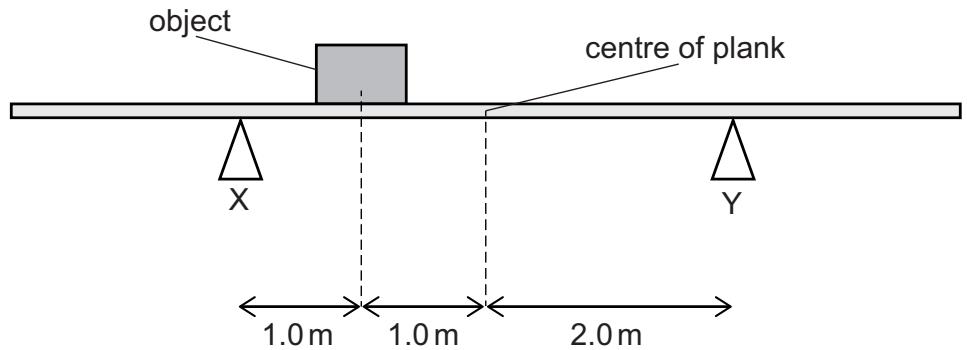
What is the contact force at X?
(gravitational field strength = )
- A.15 N
- B.35 N
- C.150 N
- D.250 N
- E.300 N
- F.350 N
- G.375 N
Answer: F
Question 81
1 markEvaluate
- A.-2
- B.3
- C.4
- D.6
- E.
- F.
Answer: C
Question 82
1 markAn object X of mass 2.0 kg is initially moving at a speed of on a smooth, horizontal surface.
A 5.0 N force is applied to X in the direction of its motion for 3.0 seconds.
A short time later it collides head on with, and sticks to, a stationary object Y of mass 3.0 kg.
What is the speed of X and Y as they move off together after the collision?
A 5.0 N force is applied to X in the direction of its motion for 3.0 seconds.
A short time later it collides head on with, and sticks to, a stationary object Y of mass 3.0 kg.
What is the speed of X and Y as they move off together after the collision?
- A.
- B.
- C.
- D.
- E.
Answer: D
Question 83
1 markCircle C has equation
The length of the tangent from the circle C to the point P is
What is the shortest distance from P to C?
The length of the tangent from the circle C to the point P is
What is the shortest distance from P to C?
- A.
- B.
- C.
- D.5
- E.10
Answer: C
Question 84
1 markTwo solid spheres X and Y have masses and respectively. They travel in opposite directions towards each other along the same line with speeds and respectively and collide head on.
The graph shows the variation of velocity with time for sphere X before, during, and after the collision.
Which sketch shows the variation of velocity with time for sphere Y?
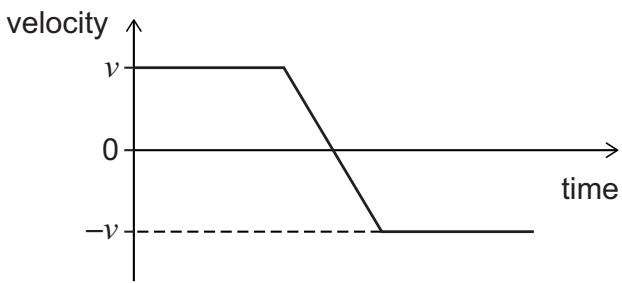
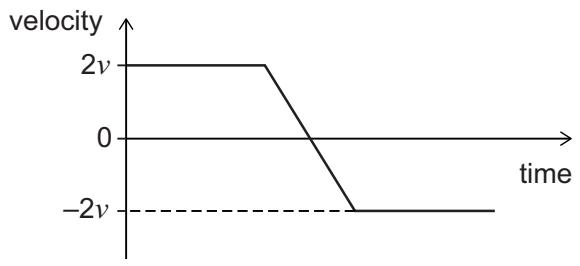
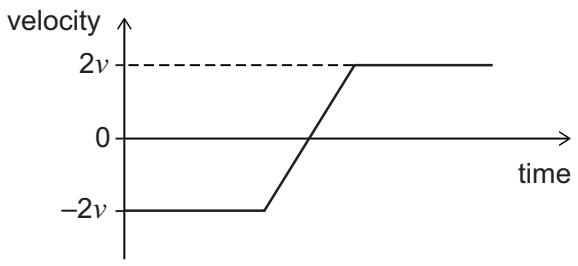
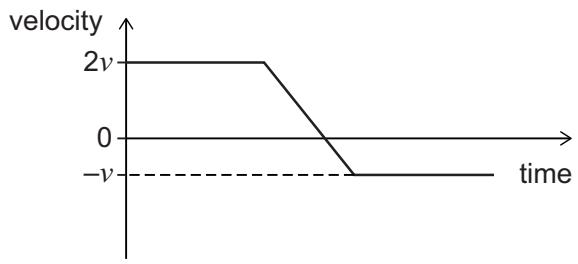
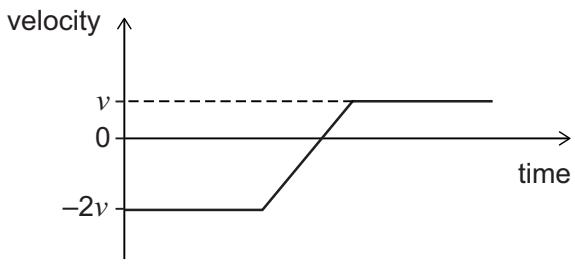
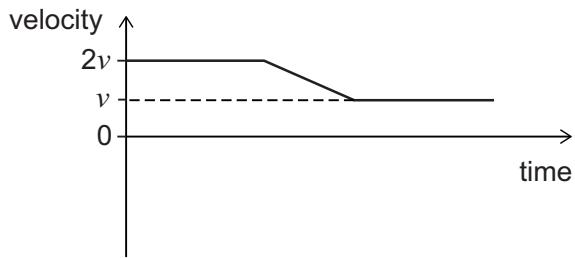
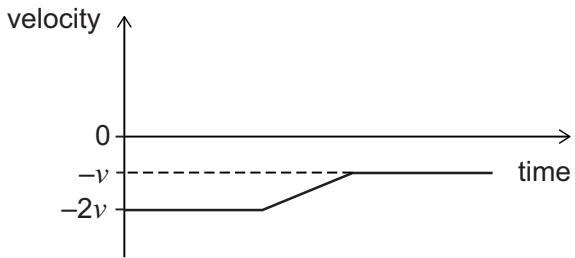
The graph shows the variation of velocity with time for sphere X before, during, and after the collision.
Which sketch shows the variation of velocity with time for sphere Y?
- A.Graph showing initial velocity -2v and final velocity v.
- B.Graph showing initial velocity -2v and final velocity 2v.
- C.Graph showing initial velocity -2v and final velocity -v.
- D.Graph showing initial velocity v and final velocity 2v.
- E.Graph showing initial velocity v, dipping during collision, and final velocity v.
- F.Graph showing initial velocity -v and final velocity v.
Answer: F
Question 85
1 markWhat is the coefficient of in the expansion of ?
- A.-6400
- B.-640
- C.-80
- D.0
- E.80
- F.800
- G.960
Answer: D
Question 86
1 markA metal ball suspended from a steel cable is held at rest by a horizontal force P. The cable makes an angle of 30° to the vertical as shown in the diagram. The cable exerts a force T on the ball.
What is the magnitude of P?
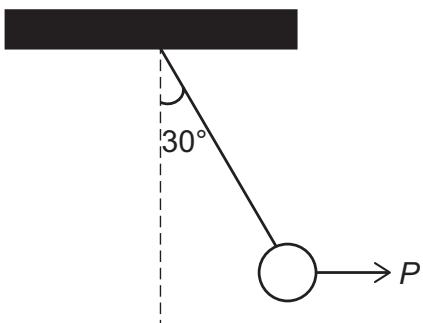
What is the magnitude of P?
- A.
- B.T
- C.2T
- D.
- E.
- F.
- G.
Answer: A
Question 87
1 markGiven that
and
what is the value of ?
and
what is the value of ?
- A.
- B.
- C.
- D.
- E.
- F.
Answer: E
Question 88
1 markA pendulum bob of mass 10 g is suspended by a light, inextensible string of length 50 cm.
The bob is released from rest at position X.
What is the speed of the bob as it passes through position Y?
(gravitational field strength ; assume that resistive forces are negligible)
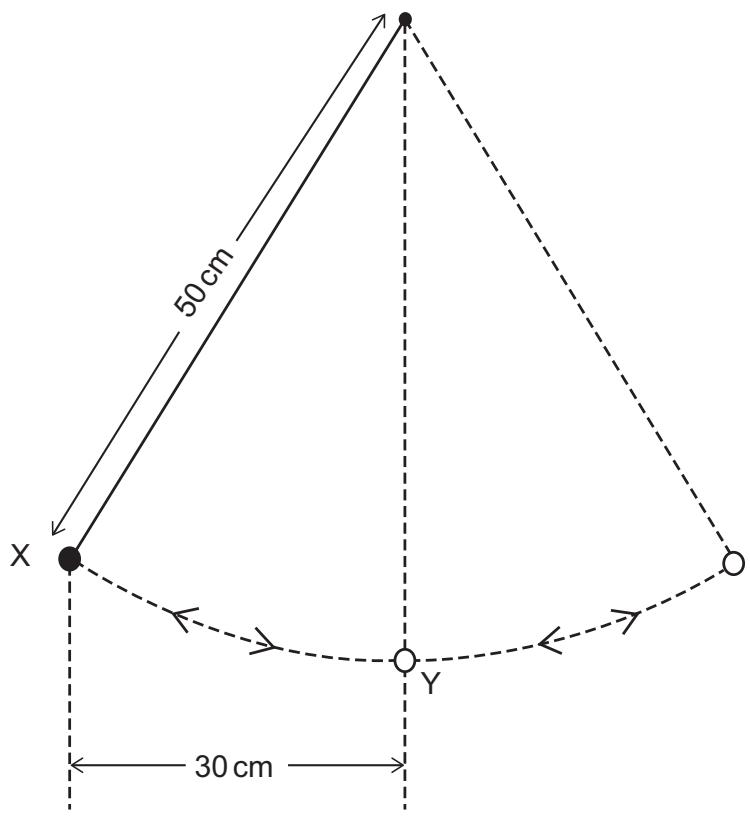
The bob is released from rest at position X.
What is the speed of the bob as it passes through position Y?
(gravitational field strength ; assume that resistive forces are negligible)
- A.
- B.
- C.
- D.
- E.
Answer: A
Question 89
1 markThe dimensions of a solid cuboid, in cm, are , and
The volume of the cuboid is .
At this volume, the surface area of the cuboid has its maximum value.
What is the area, in cm², of the face that has the largest area?
The volume of the cuboid is .
At this volume, the surface area of the cuboid has its maximum value.
What is the area, in cm², of the face that has the largest area?
- A.
- B.72
- C.96
- D.432
- E.
Answer: C
Question 90
1 markAn object is thrown vertically upwards from ground level with an initial velocity of .
2.0 seconds later another object is released from a height above the ground and falls vertically from rest.
Both of the objects hit the ground at the same time.
From what height above the ground was the second object released?
(gravitational field strength ; air resistance can be ignored)
2.0 seconds later another object is released from a height above the ground and falls vertically from rest.
Both of the objects hit the ground at the same time.
From what height above the ground was the second object released?
(gravitational field strength ; air resistance can be ignored)
- A.80 m
- B.180 m
- C.320 m
- D.500 m
- E.900 m
Answer: B