Temperature and pH Effects on Enzyme Action
Updated July 2026
Enzymes are biological catalysts that regulate metabolic reactions in living organisms. For the ESAT, students must understand how temperature and pH influence the active site and the overall rate of reaction. This topic covers the mechanism of enzyme specificity, the lock and key hypothesis, and the critical concept of denaturation.
Enzymes are protein catalysts with specific active sites that bind to complementary substrates. The rate of enzyme action is highest at optimum temperature and pH, beyond which the enzyme denatures, losing its functional shape and catalytic ability.
Enzymes as Biological Catalysts
Metabolic processes within cells are driven by chemical reactions. These reactions require catalysts to increase their speed because, without them, the processes would occur too slowly to support life. Enzymes are primarily proteins that function as biological catalysts, facilitating essential pathways such as respiration, protein synthesis, photosynthesis, and digestion. The specific enzymes present in a cell determine which metabolic pathways are active at any given time.
The Active Site and Enzyme Specificity
Enzymes possess a specific area known as the active site. This region has a unique three-dimensional shape where the chemical reactions occur.
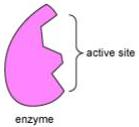
Enzymes are highly specific, meaning they only interact with a particular substrate or type of molecule. For example, starch acts as a substrate for the enzyme amylase, while proteins are the substrate for proteases. This relationship is often explained using the lock and key hypothesis. In this model, the active site is the lock and the substrate is the key. Only a substrate with a complementary shape can fit into the active site to allow a reaction to proceed.


Breaking Substrates and Making Products
Enzymes convert substrates into new substances called products. During this process, the enzyme and substrate join temporarily to form an enzyme substrate complex (ESC). It is important to note that the enzyme itself remains unchanged by the reaction and is not used up, allowing it to be reused multiple times.





An enzyme might break one substrate into two products through a hydrolysis reaction, which involves the addition of water. Alternatively, it may join two substrates to form a single product through a condensation reaction, which involves the removal of water.


Induced Fit Theory of Enzyme Action
While the lock and key model emphasizes static shapes, the induced fit theory suggests that the active site is slightly flexible. When the correct substrate enters the active site, the enzyme changes its shape slightly to fit more tightly around the substrate. This adjustment helps the reaction occur more efficiently.
Worked Exercises
Exercise 26
Question: Why are catalysts necessary in order for reactions to take place in organisms?
Answer: Catalysts are essential because they speed up metabolic reactions. Without enzymes, these chemical processes would happen too slowly to sustain the life of the organism.
Exercise 27
Question: Some enzymes were mixed with a substrate. Explain why only enzyme Y catalyses the reaction with this substrate.

Answer: Enzyme Y is the only one with an active site that has a complementary shape to the substrate. Due to enzyme specificity, the substrate can only fit into the active site of enzyme Y to form an enzyme substrate complex.
Optimum Conditions and Denaturation
Every enzyme has an optimum temperature and an optimum pH at which it functions most effectively. When environmental conditions shift away from these optima, the rate of reaction decreases. This decline happens because there is either less energy available for the reaction or the bonds maintaining the enzyme's three-dimensional shape break. When the shape of the active site is permanently altered so the substrate can no longer fit, the enzyme is described as denatured. A denatured enzyme is no longer complementary to its substrate.

The Effect of Temperature
Changing the temperature significantly impacts the rate of enzyme catalysed reactions.
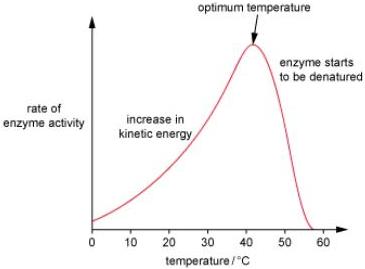
- As temperature increases, enzymes and substrates gain more kinetic energy and move faster.
- This higher kinetic energy increases the frequency and force of collisions between substrates and active sites, raising the reaction rate.
- The reaction reaches its maximum speed at the optimum temperature.
- Beyond the optimum temperature, the enzyme begins to denature as internal bonds break.
- Once the active site's functional shape is destroyed, the enzyme can no longer catalyse the reaction, even if the temperature is subsequently lowered.
The Effect of pH
Different enzymes have different optimum pH levels depending on their location in the body. For instance, enzymes in the stomach usually have an optimum of approximately pH 2, while those in the small intestine have an optimum of approximately pH 8.
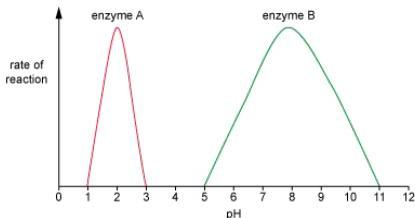
As the pH moves away from the optimum in either direction, the enzyme starts to denature, causing the reaction rate to fall. Once the functional shape of the active site is destroyed by extreme pH, the enzyme cannot be restored to functionality even if the pH returns to the optimum level.
Key takeaways
- Enzymes are specific biological catalysts with a unique three-dimensional active site complementary to their substrate.
- The lock and key hypothesis and induced fit theory describe how substrates bind to the active site to form an enzyme substrate complex.
- Increasing temperature increases kinetic energy and collision frequency until the optimum temperature is reached.
- Extreme temperatures or pH levels cause denaturation, an irreversible change in the active site shape that stops enzyme function.
In exam questions, be careful not to say that enzymes are 'killed' by high temperatures. Enzymes are molecules, not living organisms. Always use the term 'denatured' to describe the loss of their structural integrity.
A common mistake is assuming that all enzymes have an optimum pH of 7. While many do, always check the context of the question (e.g., stomach vs. intestine) as optima can vary significantly.
The sensitivity of enzymes to temperature and pH is why homeostasis is so critical in complex organisms. Maintaining a stable internal environment ensures that metabolic reactions occur at the consistent rates necessary for survival.
Frequently asked questions
Does a denatured enzyme start working again if the temperature is lowered?
No. Denaturation is a permanent change to the three-dimensional structure of the protein. Once the active site has lost its functional shape, it can no longer bind to the substrate, regardless of whether the temperature returns to normal.
Why do different enzymes have different optimum pH levels?
Optimum pH is an adaptation to the environment where the enzyme functions. For example, pepsin in the stomach works best at pH 2 to match the acidic conditions, whereas enzymes in the small intestine work best in slightly alkaline conditions around pH 8.
What is the difference between a hydrolysis reaction and a condensation reaction?
A hydrolysis reaction involves breaking down a substrate into products by adding a water molecule. A condensation reaction involves joining substrates together to form a larger product, which results in the removal of a water molecule.
How does the induced fit theory differ from the lock and key hypothesis?
The lock and key hypothesis suggests the active site and substrate are perfectly rigid and complementary. The induced fit theory suggests the active site is flexible and changes shape slightly to wrap more tightly around the substrate once it enters.