Inheritance and Genetic Terminology for the ESAT
Updated July 2026
Understanding the language of genetics is fundamental for the Biology section of the ESAT. This page covers essential definitions including genes, alleles, and genotypes, while exploring how traits are passed from parents to offspring. It explains the mechanics of dominant and recessive inheritance through monohybrid crosses and pedigree analysis, showing that humans have 22 pairs of autosomes.
Genetic inheritance is the process by which DNA, organised into chromosomes and genes, determines an organism's traits. Traits are controlled by alleles, which combine to form a genotype that is expressed as a physical phenotype.
Chromosomes and Genes
Most animal and plant cells contain a nucleus that acts as the control centre for cellular activities. Within the nucleus, genetic material is stored in the form of linear structures called chromosomes. A chromosome is a long, thread-like structure composed of DNA wrapped tightly around proteins to ensure it fits within the nucleus. In humans, there are 46 chromosomes in total, arranged in 23 pairs.
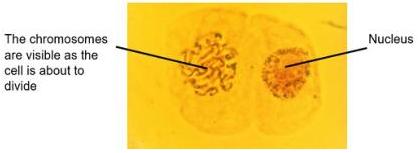
Of these 23 pairs, one pair consists of the sex chromosomes, which determine biological sex. The remaining 22 pairs are known as autosomes. An autosome is any chromosome that is not a sex chromosome.
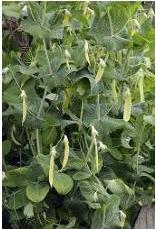
A gene is a specific, short section of a chromosome that carries the code for one particular protein. These proteins determine the characteristics of an organism, such as the colour of a flower or the texture of a pea pod.
Exercise 13: Which type of human cell has no nucleus and therefore no chromosomes?
Solution 13: Mature red blood cells.
Alleles and Genotypes
While a gene codes for a particular trait, there can be different versions of that gene. These variations are called alleles. For example, a gene might control the ability to taste a bitter chemical called PTC. One allele allows for tasting, while another does not. Humans possess two copies of every gene, one inherited from each parent via the gametes (sperm and egg cells).
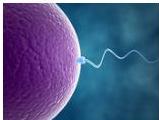
The specific combination of alleles an individual possesses is known as their genotype. By convention, alleles are represented by letters.
- Dominant alleles are always expressed in the organism's appearance if at least one copy is present. They are represented by capital letters, such as .
- Recessive alleles are only expressed if two copies are present in the genotype. They are represented by lower-case letters, such as .
Exercise 14: If the tasting allele is dominant and the non-tasting allele is recessive, which two genotypes could give a person the ability to taste PTC?
Solution 14: The genotype must contain at least one dominant allele, so it could be either or .
Homozygous and Heterozygous
Because individuals have two alleles for each gene, those alleles can be the same or different.
- Homozygous: An individual with two identical alleles for a gene (e.g., or ).
- Heterozygous: An individual with two different alleles for a gene (e.g., ).
In a heterozygous individual, the dominant allele determines the phenotype, which is the set of visible or observable characteristics. The recessive allele is present in the genotype but does not affect the phenotype in this case.
Exercise 15: Presence of hair on the second finger joint is caused by a dominant autosomal allele , while no hair is caused by the recessive allele . A child has no hair, like her mother, but her father does have hair. State the father's genotype and explain the deduction.
Solution 15: The child has no hair and must be homozygous recessive (). She inherited one from her mother and one from her father. Since the father has hair, he must have at least one dominant allele . Therefore, the father must be heterozygous ().
Monohybrid Genetic Crosses
A cross that considers the inheritance of a single gene is called a monohybrid cross. We can use genetic diagrams or Punnett squares to predict the outcomes of such matings.
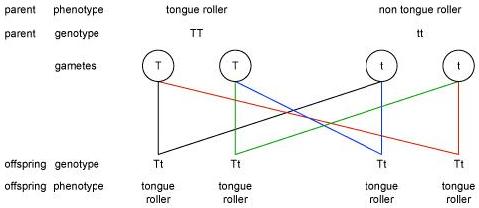
Consider tongue rolling, where the ability to roll the tongue is dominant and the inability is recessive.
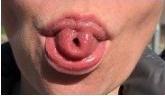
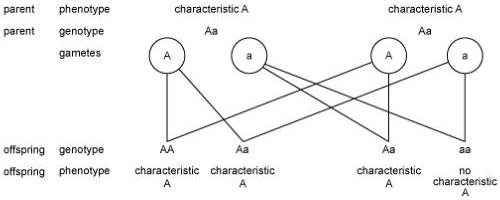
To draw a genetic diagram, we show the parent phenotypes and genotypes, the gametes they produce, and the potential combinations at fertilisation.
A Punnett square provides a clearer grid for these probabilities. For two heterozygous parents ( x ):
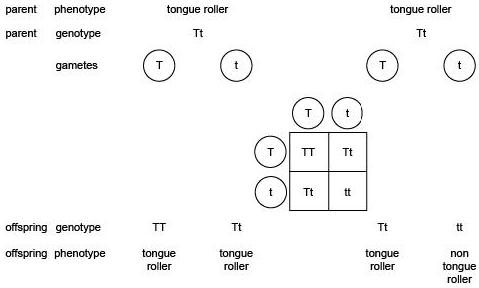
The results show a phenotypic ratio of (75% tongue rollers to 25% non-rollers).
Exercise 16: Draw a Punnett square for a heterozygous tongue roller and a non-tongue roller. State the ratio of the offspring.
Solution 16:
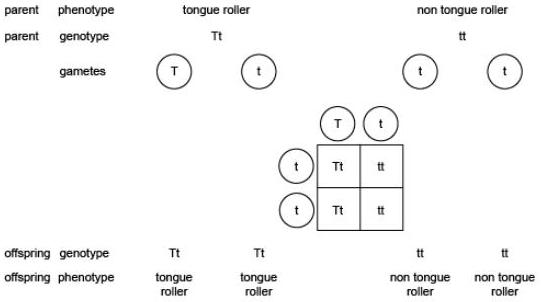 The ratio is (50% tongue rollers to 50% non-rollers).
Inherited Conditions and Pedigrees
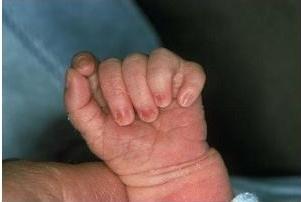
Some alleles cause genetic conditions. Polydactyly (extra digits) is caused by a dominant autosomal allele. Only one copy is needed to show the condition.
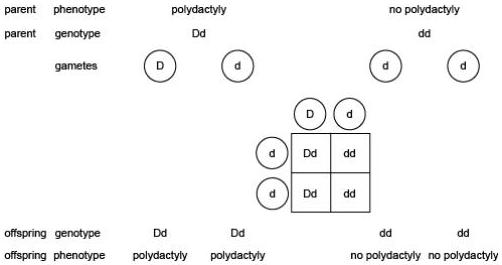
Cystic fibrosis is caused by a recessive autosomal allele . A person with the genotype is a carrier: they do not have the condition but can pass it to offspring. Affected individuals must be .
Exercise 17: Two carrier parents have four children, none of whom have cystic fibrosis. Why does this not match the expected 25% probability?
Solution 17:
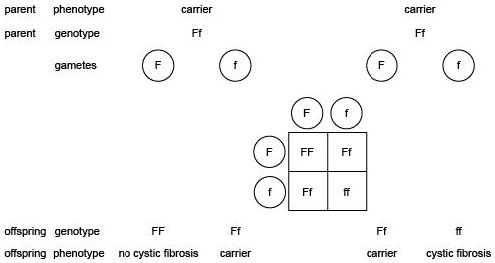 Fertilisation is a random process. In a small sample size, the actual results may deviate from the expected probability. Expected ratios are seen more clearly in large populations.
Family pedigree diagrams track these traits through generations.
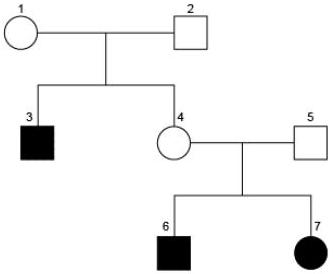
In this pedigree, if two parents without the condition (1 and 2) have a child with it (3), the condition must be recessive, and the parents must both be carriers.
Multiple Gene Inheritance
While some traits result from a single gene, most phenotypes, such as height, are the result of multiple genes acting together. This is why height shows a wide range of variation rather than distinct categories.

Exercise 18: Based on the family tree below, is characteristic A dominant or recessive? What is the probability that the next child of 3 and 4 will show it?
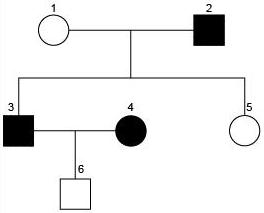
Solution 18: Characteristic A is dominant. We know this because parents 3 and 4 have the trait but produced a child without it. If it were recessive, all their children would have it. Parents 3 and 4 must be heterozygous. The probability of their next child having the trait is or 75%.
Key takeaways
- Genes are sections of DNA that code for proteins, while alleles are different versions of those genes.
- Genotype refers to the specific alleles present (e.g., , , ), while phenotype is the expressed physical characteristic.
- Dominant alleles mask the presence of recessive alleles in heterozygous individuals.
- Autosomes are the 22 pairs of human chromosomes that do not determine biological sex.
- Most human characteristics are controlled by multiple genes, although some conditions follow single-gene inheritance patterns.
In ESAT questions, look for 'hidden' information in pedigrees. If two parents with the same phenotype produce a child with a different phenotype, the parents must be heterozygous and the child's phenotype must be recessive.
Do not confuse 'dominant' with 'common'. A dominant allele like the one for polydactyly can be very rare in a population even though it always expresses itself when present.
The relationship between genotype and phenotype is the bridge between molecular biology (DNA structure) and evolutionary biology (natural selection acting on visible traits).
Frequently asked questions
Can a child have a recessive trait if neither parent shows it?
Yes, if both parents are heterozygous (carriers). Each parent can pass the recessive allele to the child, resulting in a homozygous recessive genotype () and the expression of the recessive phenotype.
What is the difference between a chromosome and an autosome?
A chromosome is a broad term for the thread-like structures of DNA in the nucleus. An autosome is a specific type of chromosome: any chromosome that is not one of the sex chromosomes ( or ).
How do you distinguish between homozygous and heterozygous genotypes?
A homozygous genotype has two of the same allele ( or ), whereas a heterozygous genotype has two different alleles ().
Why does height show a continuous range of variation?
Height is a polygenic trait, meaning it is controlled by the interaction of multiple different genes rather than a single gene. This results in a wide spectrum of possible phenotypes.