Disproportionation and Redox Agents
Updated July 2026
This lesson explores advanced redox reactions including disproportionation, where a single species is simultaneously oxidised and reduced. We define oxidising and reducing agents through oxygen transfer and electron transfer, providing the essential tools to identify these species in complex chemical equations for the ESAT.
Disproportionation occurs when a single chemical species is both oxidised and reduced in the same reaction. Oxidising agents accept electrons and are reduced, while reducing agents donate electrons and are oxidised.
Understanding Disproportionation
Disproportionation is a specific category of redox reaction. In these reactions, a single species acts as both the oxidising agent and the reducing agent, meaning it is simultaneously oxidised and reduced. To identify disproportionation, you must track the oxidation states of a specific element across the reactants and products.
Example 1: Decomposition of Hydrogen Peroxide
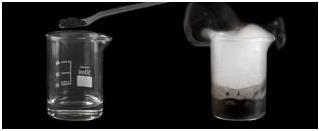
A classic example is the decomposition of hydrogen peroxide into water and oxygen:
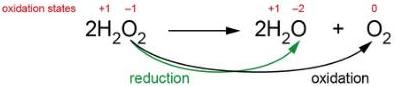
In hydrogen peroxide (), oxygen has an oxidation state of . In the products, the oxidation state changes as follows:
- The oxygen in water () has an oxidation state of . This is a decrease in oxidation state, which is reduction.
- The oxygen in elemental oxygen () has an oxidation state of zero. This is an increase in oxidation state, which is oxidation.
Because the oxygen in hydrogen peroxide has been both oxidised and reduced, it has undergone disproportionation.
Example 2: Chlorine in Sodium Hydroxide
When chlorine gas reacts with a cold, dilute solution of sodium hydroxide, the following reaction occurs:
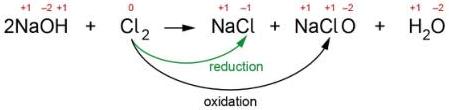
The chlorine in starts with an oxidation state of zero. In sodium chloride (), the sodium is , so the chlorine must be to ensure the compound is neutral. In sodium chlorate(I) (), the sodium is and oxygen is , so the chlorine must be to balance the sum to zero. One chlorine atom is reduced (0 to ) while another is oxidised (0 to ). Therefore, undergoes disproportionation.
Example 3: Copper(I) Ions
In aqueous solutions, copper(I) ions () are unstable and undergo disproportionation:
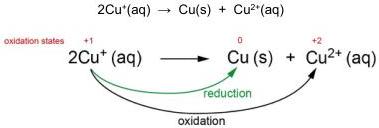
The oxidation state of a monatomic ion is equal to its charge. Thus, is and is . Elemental copper () is zero. One ion is reduced to (0), and another is oxidised to ().
Practice with Disproportionation Reactions
Exercise: Nitrogen Dioxide and Water
Consider the reaction:
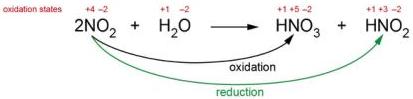
In , nitrogen has an oxidation state of . In , using and , nitrogen is calculated as . In , nitrogen is . One nitrogen atom increases from to (oxidation) and the other decreases from to (reduction). This is disproportionation.
Exercise: Chlorine and Hot Sodium Hydroxide
When the sodium hydroxide solution is hot, the reaction changes:

Chlorine in is zero. In , it is . In , the oxidation state of Cl is (since and ). Since chlorine is both reduced to and oxidised to , this is a disproportionation reaction.
Oxidising and Reducing Agents
Redox reactions involve two specific roles: the oxidising agent and the reducing agent. These can be defined in two ways.
1. In terms of Oxygen Transfer
- Oxidising agents provide oxygen to another substance.
- Reducing agents remove oxygen from another substance.
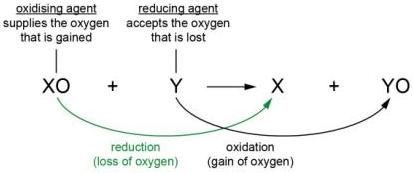
For example, in the reaction :
- is the oxidising agent because it provides the oxygen that the carbon monoxide gains.
- is the reducing agent because it removes the oxygen from the iron(III) oxide.
2. In terms of Electron Transfer
- Oxidising agents oxidise another species. Since oxidation is the loss of electrons, the oxidising agent must take those electrons. Therefore, the oxidising agent gains electrons and is itself reduced.
- Reducing agents reduce another species. Since reduction is the gain of electrons, the reducing agent must supply them. Therefore, the reducing agent loses electrons and is itself oxidised.
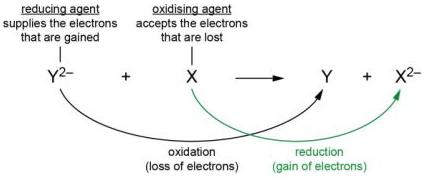
Consider the reaction between zinc and copper(II) ions: .
- atoms lose electrons to become . Thus, is the reducing agent.
- ions gain electrons to become atoms. Thus, is the oxidising agent.
Identifying Agents in Displacement Reactions
Look at the reaction: .
Each iodide ion () loses an electron to form iodine (). Their oxidation state increases from to . They are being oxidised, so is the reducing agent. The chlorine molecule () gains these electrons to form chloride ions (). Its oxidation state decreases from to . It is being reduced, so is the oxidising agent.
Similarly, in the reaction :
- Magnesium () is oxidised (0 to ), making it the reducing agent.
- Hydrogen ions () are reduced ( to 0), making them the oxidising agent.
Trends in the Periodic Table
Chemical behavior follows periodic trends:
- Group 2 elements react by losing electrons to form positive ions. Because they lose electrons (oxidation), they are excellent reducing agents.
- Group 17 elements react by gaining electrons to form negative ions. Because they gain electrons (reduction), they are excellent oxidising agents.
Key takeaways
- Disproportionation is a reaction where one species is both oxidising and reducing itself simultaneously.
- Oxidising agents are electron acceptors that undergo reduction during a reaction.
- Reducing agents are electron donors that undergo oxidation during a reaction.
- The oxidation state of an element in its standard state is always zero, while in monatomic ions, it equals the charge.
When asked to identify agents in the ESAT, always write out the oxidation states above every atom in the equation first. The species whose oxidation state increases is the reducing agent; the species whose oxidation state decreases is the oxidising agent.
Be careful when identifying the 'agent'. The agent is the entire reactant species (e.g., ), not just the specific atom (Fe) within that species that changes state.
Elements with high electronegativity, such as fluorine and chlorine in Group 17, are typically the strongest oxidising agents because they have a very high affinity for electrons.
Frequently asked questions
Can a reaction be disproportionation if two different elements are oxidised and reduced?
No. Disproportionation specifically requires that the same element in the same starting species is both oxidised and reduced.
Is the oxidising agent the substance that is oxidised?
No, this is a common confusion. The oxidising agent causes oxidation in another substance by taking its electrons; therefore, the oxidising agent is itself reduced.
How do I calculate the oxidation state of chlorine in sodium chlorate(V)?
In , Na is and each O is . The sum must be zero: . This gives , so .