Oxidising Agents Reducing Agents and Disproportionation
Updated July 2026
This lesson covers the specific roles substances play in redox reactions. You will learn to identify oxidising and reducing agents through oxygen transfer and electron loss or gain. Additionally, we explore disproportionation, a unique process where a single species is simultaneously oxidised and reduced, using examples like hydrogen peroxide and chlorine.
An oxidising agent gains electrons (is reduced) to oxidise another substance, while a reducing agent loses electrons (is oxidised) to reduce another substance. Disproportionation occurs when a single chemical species is both oxidised and reduced in the same reaction.
Understanding Disproportionation
Disproportionation is a specific category of redox reaction. It occurs when a single species is simultaneously both oxidised and reduced. To identify these reactions, you must track the oxidation states of a specific element as it moves from the reactants to the products.
A classic example is the decomposition of hydrogen peroxide:
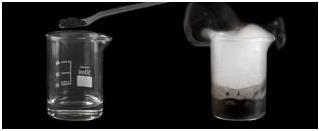
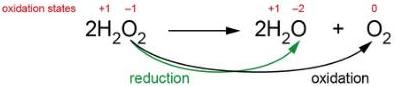
In hydrogen peroxide (), oxygen has an oxidation state of . In the products, the oxygen in water has an oxidation state of , while the oxygen in elemental oxygen () has an oxidation state of . Consequently, two of the four oxygen atoms in the reactants have seen their oxidation state decrease from to (reduction), while the other two have seen their oxidation state increase from to (oxidation). Because the oxygen has been simultaneously oxidised and reduced, it has undergone disproportionation.
Further Examples of Disproportionation
- The reaction of chlorine with cold, dilute sodium hydroxide solution:
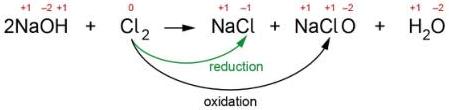
The chlorine atoms in start with an oxidation state of . In sodium chloride (), the chlorine has an oxidation state of (reduction). In sodium chlorate(I) (), where sodium is and oxygen is , the chlorine must have an oxidation state of to ensure the sum of oxidation states is zero (oxidation). Thus, chlorine has undergone disproportionation.
- The disproportionation of ions in aqueous solution:
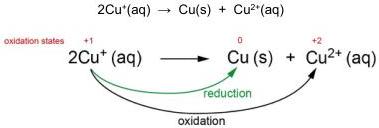
One ion (oxidation state ) reduces to elemental copper (oxidation state ), while another ion oxidises to (oxidation state ).
Worked Exercises: Identifying Disproportionation
Exercise 56: Nitrogen Dioxide and Water
Consider the reaction:
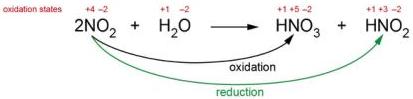
In , nitrogen is in the oxidation state. In nitric acid (), the nitrogen is (oxidation). In nitrous acid (), the nitrogen is (reduction). This confirms the nitrogen in has undergone disproportionation.
Exercise 57: Chlorine and Hot Sodium Hydroxide
Consider the reaction:

Elemental chlorine () has an oxidation state of . In , it is . In , the oxidation state of chlorine is because the sodium is and the three oxygens total . Five chlorine atoms are reduced, and one is oxidised. This is a disproportionation reaction.
Oxidising and Reducing Agents: Oxygen Transfer
In reactions involving oxygen transfer, we use the following definitions:
- Oxidising agents provide oxygen to another substance.
- Reducing agents remove oxygen from another substance.
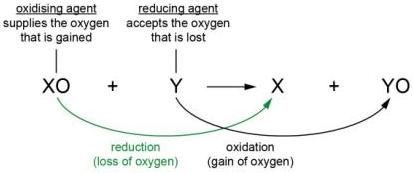
In the reaction between iron(III) oxide and carbon monoxide: . The iron(III) oxide is reduced to iron by losing oxygen, making it the oxidising agent. The carbon monoxide is oxidised to carbon dioxide by gaining oxygen, making it the reducing agent.
Oxidising and Reducing Agents: Electron Transfer
When reactions are viewed through electron movement:
- An oxidising agent oxidises another species by taking its electrons. Therefore, the oxidising agent gains electrons and is itself reduced.
- A reducing agent reduces another species by supplying electrons. Therefore, the reducing agent loses electrons and is itself oxidised.
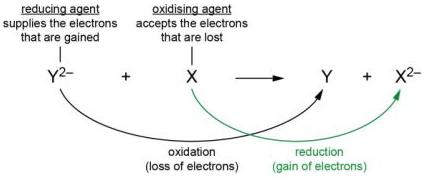
In the reaction between zinc and copper(II) ions: . Zinc atoms lose electrons to become (oxidation), so zinc is the reducing agent. Copper(II) ions gain electrons to become copper atoms (reduction), so is the oxidising agent.
Systematic Identification Method
To identify the agents in a reaction such as , follow these steps:
- Determine what has been oxidised and reduced. Here, iodide ions () lose electrons to form (oxidation), while chlorine () gains electrons to form (reduction).
- Apply the definitions. The species that is reduced is the oxidising agent (). The species that is oxidised is the reducing agent ().
In the case of Group 2 and Group 17 elements: Group 2 metals lose electrons to form positive ions (oxidation), making them effective reducing agents. Group 17 non-metals gain electrons to form negative ions (reduction), making them effective oxidising agents.
Key takeaways
- An oxidising agent is a species that is reduced in a reaction because it accepts electrons.
- A reducing agent is a species that is oxidised in a reaction because it donates electrons.
- Disproportionation is a unique redox reaction where the same element in a single species increases and decreases its oxidation state simultaneously.
- In terms of oxygen, the substance that supplies oxygen is the oxidising agent, and the substance that accepts it is the reducing agent.
When asked to identify agents in the ESAT, always calculate the oxidation states for every element in the equation first. The reactant containing the element that is reduced is always your oxidising agent, and the reactant containing the element that is oxidised is your reducing agent.
Be careful with terminology: the substance that is oxidised is the reducing agent, and the substance that is reduced is the oxidising agent. Students often swap these terms in the high-pressure environment of an exam.
Disproportionation often occurs when an element is in an intermediate oxidation state. For example, nitrogen in () can move to both and because those states are more stable under specific conditions, like reaction with water.
Frequently asked questions
Can a single substance be both an oxidising and a reducing agent?
Yes, in a disproportionation reaction, a single substance acts as both because one part of it is oxidised while another part is reduced. An example is the decomposition of hydrogen peroxide ().
If a substance gains oxygen, what type of agent is it reacting with?
If a substance gains oxygen, it is being oxidised. The substance that provided that oxygen is the oxidising agent.
Why are Group 17 elements considered good oxidising agents?
Group 17 elements have high electronegativities and a strong tendency to gain electrons to achieve a full outer shell. Since gaining electrons is reduction, they readily oxidise other substances.