Magnetism Properties and Field Patterns
Updated July 2026
This study guide explores the fundamental properties of magnets, including pole interactions, field line conventions, and the distinction between hard and soft magnetic materials. You will learn how to identify magnetic poles, map fields using iron filings or compasses, and understand the mechanism of induced magnetism.
Magnets possess two poles where like poles repel and unlike poles attract. Magnetic fields are represented by lines directed from north to south, with material classifications determined by their ability to retain or lose magnetisation.
Poles and Magnetic Forces
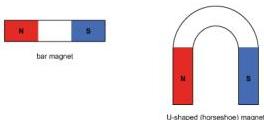
Permanent magnets are characterized by having two distinct poles: a north pole () at one end and a south pole () at the other. These magnets can be found in various shapes and sizes, such as bar magnets or horseshoe magnets.
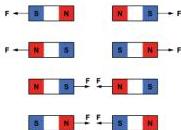
When two magnets are brought close together, they exert non contact forces on each other. The behavior of these forces follows two fundamental rules: like poles repel (for example, and or and ) and unlike poles attract (for example, and ). These forces are at their strongest when the poles are nearest to each other and diminish as the distance between the magnets increases.
A magnet will also attract specific magnetic materials, namely iron, cobalt, and nickel. It is important to note that while attraction occurs between a magnet and a magnetic material, only repulsion can definitively prove that an object is a permanent magnet. Attraction only demonstrates that an object is magnetic, not that it possesses its own permanent field.
North-seeking and South-seeking Poles
The terms north and south on a bar magnet actually refer to north-seeking and south-seeking. If a bar magnet is suspended or pivoted so it can rotate freely, it will align itself with the Earth magnetic field. The north-seeking pole will point toward the geographic north pole of the Earth, and the south-seeking pole will point toward the geographic south pole.
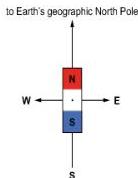
Because opposite poles attract, this implies a surprising fact about our planet: the Earth geographic north pole is actually a magnetic south-seeking pole, while the geographic south pole is a magnetic north-seeking pole.
The Magnetic Compass
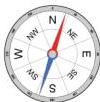
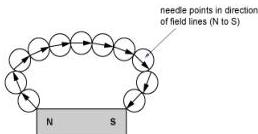
A magnetic compass contains a small bar magnet pivoted at its center. It is a vital tool for navigation and for investigating magnetic fields. The needle of the compass aligns with the local magnetic field, pointing away from magnetic north poles and toward magnetic south poles.
Worked Example: Identifying Poles
A student is given an unmarked bar magnet and must identify the north pole. Here are the methods they could use:
- Using a compass: The compass needle points away from the north pole and toward the south pole. By placing the compass near one end, the student can see if the needle points toward or away from that end.
- Using a marked magnet: The student can bring the north pole of a known magnet toward one end of the unmarked magnet. If they repel, the unmarked end is a north pole. If they attract, the other end of the unmarked magnet is the north pole.
- Why iron filings fail: While iron filings show the shape of the magnetic field, they do not have a marked direction. The student would see the field lines but would be unable to distinguish which end is north and which is south.
Magnetic Fields and Field Lines
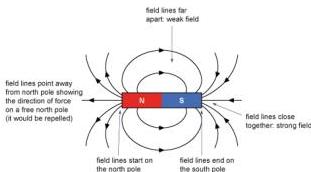
A magnetic field is defined as the region around a magnet where magnetic forces act on other magnets or magnetic materials. We represent these fields using magnetic field lines. These lines follow specific rules:
- They start at north poles and end at south poles, or form continuous closed loops.
- They never cross one another.
- They represent the direction of force that would act on a theoretical free north pole.
- The density of the lines indicates field strength: where the lines are closer together, the field is stronger.
Visualising Magnetic Field Patterns
Two common methods are used to visualize the invisible fields surrounding magnets.
Iron Filings
Iron is a soft magnetic material that becomes magnetised in the presence of a field. When iron filings are scattered on a card over a magnet, each tiny filing acts like a miniature compass needle and aligns with the field. Tapping the card overcomes friction, allowing the filings to form a clear pattern of the field lines.
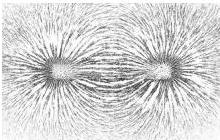
Note that this method shows the pattern and relative strength of the field but does not indicate the direction from north to south.
Plotting Compasses
A small plotting compass can be moved around a magnet to trace the direction of the field lines. By marking the direction the needle points at various locations, a student can map the full shape and direction of the field.
Worked Example: Interpreting Filings
Consider the following pattern of iron filings between two magnets:
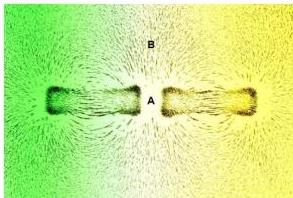
Is the force between these magnets attraction or repulsion? Look at point and point . At point , there are almost no filings, indicating a very weak or zero field. This occurs when the fields from two identical poles cancel each other out. At point , the field lines reinforce each other. Therefore, the force is repulsion, meaning the two poles facing each other are the same.
Hard and Soft Magnetic Materials
Magnetic materials are classified by how easily they can be magnetised and how well they retain that magnetism. This is unrelated to their physical or mechanical hardness.
- Soft magnetic materials: These are easy to magnetise but lose their magnetism easily. Iron is the primary example.
- Hard magnetic materials: These are difficult to magnetise but retain their magnetism for a long time once magnetised. Steel is a common example.
Applications of Materials
- Electromagnets: These use a soft iron core. When current flows through the surrounding coil, the core becomes magnetised. When the current stops, the core quickly loses its magnetism, allowing the electromagnet to be switched off.
- Permanent magnets: These are made from hard materials like steel. Once they are magnetised, they stay magnetised for long periods, which is necessary for compass needles, loudspeaker magnets, and refrigerator magnets.
Induced Magnetism
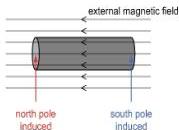
When a piece of unmagnetised magnetic material is placed in a magnetic field, it becomes a magnet itself. This is called induced magnetism. The process always results in attraction because the field induces an opposite pole on the nearest part of the material. For instance, bringing a north pole near a piece of iron induces a south pole on the side of the iron closest to the magnet.
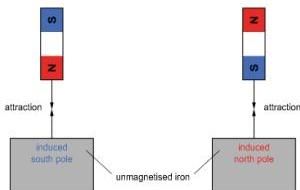
Permanent magnets are created by placing hard magnetic materials into very strong magnetic fields, such as inside a solenoid. The induced poles remain even after the external field is removed.
Worked Example: The Cylinder Puzzle
You have two metal cylinders, and . Any combination of ends results in attraction. Which of the following is true? 1) Both are magnets, 2) is a magnet and is iron, 3) is a magnet and is iron, 4) Both are iron.
Analysis: If both were magnets, they would repel when like poles met. Since they always attract, they cannot both be magnets. If both were iron, there would be no force at all. Therefore, one must be a permanent magnet and the other must be an unmagnetised magnetic material like iron, which experiences induced magnetism and subsequent attraction regardless of which pole approaches it. Statements 2 and 3 are possible.
Key takeaways
- Like poles repel and unlike poles attract: this is the fundamental law of magnetic force.
- Magnetic field lines always flow from the north pole to the south pole and never cross.
- Repulsion is the only definitive test for a permanent magnet, as attraction can occur due to induced magnetism in unmagnetised materials.
- Soft magnetic materials like iron are used for temporary magnets (electromagnets), while hard materials like steel are used for permanent magnets.
In exam questions, if you are asked to prove an object is a magnet, always specify that it must repel a known magnet. Do not rely on attraction.
Do not confuse magnetic hardness with physical hardness. A physically soft piece of steel is still a 'hard' magnetic material because it retains its magnetism.
The concept of induced magnetism explains why magnets always attract unmagnetised paperclips or fridge doors: the proximity of the magnet actually reorganises the material at a microscopic level to create a temporary opposite pole.
Frequently asked questions
Why does a compass needle point toward the geographic north pole?
The needle of a compass is a small magnet. Its north-seeking pole is attracted to the Earth magnetic south pole, which is located near the geographic north pole.
Can magnetic field lines ever start or end in empty space?
No. Magnetic field lines must either start on a north pole and end on a south pole or form continuous closed loops. They cannot simply terminate in space.
What happens if you heat a permanent magnet?
Heating a hard magnetic material can cause it to become demagnetised as the internal alignment of the magnetic components is disrupted by thermal energy.
Why are iron filings better than a compass for seeing the whole field at once?
Iron filings provide a simultaneous view of the entire field pattern across a large area, whereas a plotting compass only shows the field direction at one specific point at a time.