Mechanics: Forces and Force Diagrams for the ESAT
Updated July 2026
This lesson covers the fundamental nature of forces for the ESAT Physics section. It explores the various types of forces, from weight to electrostatic, the factors determining their magnitude, and the essential techniques for drawing force diagrams and calculating resultant forces in one dimension.
A force is a vector quantity representing a push or pull exerted by one object on another, whose magnitude and direction depend on specific physical factors and whose combined effect is known as the resultant force.
Understanding Types of Force
A force is the application of a push or a pull to an object by another object. Because forces have both magnitude and direction, they are vector quantities, measured in newtons (). In physics, many different types of forces arise depending on the situation.
The following table summarises the primary types of force, their causes, and the factors determining their magnitude and direction:
| Type of force | Cause | Magnitude depends on | Direction |
|---|---|---|---|
| weight | mass in a gravitational field | mass, gravitational field strength | downwards |
| normal contact | two solid objects in contact | physical properties of contact | normal to surface of contact |
| drag | movement through a fluid | speed, cross-sectional area | opposite to relative motion |
| friction | relative sliding between solids | nature of surfaces | opposite to relative motion |
| magnetic | magnets or current in field | field strength, current | attraction/repulsion |
| electrostatic | charges in an electric field | electric field strength | like charges repel, opposites attract |
| upthrust | solid immersed in a fluid | weight of fluid displaced | upwards |
| thrust | driving force from an engine | power of engine | direction of propulsion |
| lift | aerofoil moving through fluid | speed, fluid density, wing shape | normal to wing |
| tension | stretched spring, string, or wire | extension | along the string/spring/wire |
Important Distinctions
-
Avoid the word reaction: While some texts refer to normal contact force as a reaction force, this is misleading and can cause confusion with Newton's third law. Use the term normal contact force instead.
-
Resistive Forces: Both drag (such as air resistance) and friction act to oppose motion. Drag occurs through fluids (liquids or gases), while friction occurs between solid surfaces. These are often grouped together as total resistive forces.
-
Non-contact vs. Contact Forces: Most forces require physical contact. However, weight (gravitational), magnetic, and electrostatic forces can be exerted over a distance without contact. These are known as field forces.
Worked Example: Force vs. Energy
Scenario: A student claims that a football kicked along the ground comes to rest because it has transferred its energy to friction.
Explanation: This is not a precise explanation because friction is a force, not a form of energy. A better explanation is that as the ball moves, a resultant friction force acts in the opposite direction. The ball does work () against this friction force, which transfers the kinetic energy of the ball into thermal energy in the surroundings.
Drawing and Interpreting Force Diagrams
Analysing the forces acting on an object is essential for solving equilibrium and motion problems. Every force on an object is exerted by another distinct object. When drawing force diagrams, follow these rules:
- Every force is represented by an arrow starting at the point on the object where the force acts (or can be considered to act).
- Arrows must point away from the object in the direction the force is applied.
- Arrows should be labelled with the type of force, the object exerting it, and its magnitude.
- Resultant force is never added as an extra arrow. It is the combination of the existing forces, not a separate physical force.
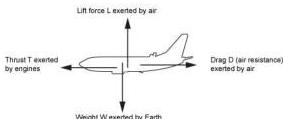
Example 1: Aircraft in Horizontal Flight
Four main forces act on an aircraft:
- Thrust: Exerted by engines, directed forwards.
- Drag: Exerted by air, directed backwards.
- Weight: Exerted by the Earth, acting at the centre of gravity, directed downwards.
- Lift: Exerted by air on the wings, directed upwards.
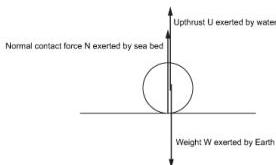
Example 2: Rock Resting on the Seabed
Three vertical forces act on the rock:
- Weight: Exerted by the Earth, directed downwards.
- Normal contact force: From the seabed, directed upwards.
- Upthrust: From displaced water, directed upwards.
Worked Example: Moored Boat
Question: Draw a free body diagram for a boat moored at rest on the sea and describe the forces.
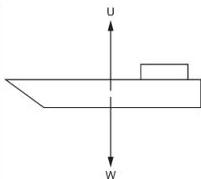
Answer: is the upthrust from the seawater (due to displaced water). is the weight of the boat caused by Earth's gravity. Since the boat is at rest, the resultant force is zero, meaning the magnitudes of and are equal.
Resultant Force in One Dimension
The resultant force is the vector sum of all forces acting on an object. It is the single value that determines whether an object accelerates or deforms. To calculate it in one dimension, subtract the total force in one direction from the total force in the opposite direction.
- If the forces in opposing directions are equal, the resultant force is zero (the forces are balanced).
- If forces act in multiple dimensions, calculate the resultant for each dimension separately.
Worked Example: Aircraft Forces
Scenario: An aircraft has a thrust () of , weight () of , lift () of , and drag () of .
Calculation:
- Horizontally: Resultant = .
- Vertically: Resultant = . Since the vertical forces balance, the total resultant force is forwards.
Worked Example: Rock on Seabed
Scenario: A rock has a weight () of and upthrust () of . The resultant force is zero.
Calculation: For the resultant to be zero, total upwards force must equal the downwards force (). Total upwards force = . Therefore, .
Worked Example: Firework Launch
Question: A firework of mass is launched vertically with a thrust of . What is the resultant force at launch?
Calculation:
- Calculate Weight: .
- Calculate Resultant: vertically upwards.
Key takeaways
- Forces are vectors: always specify both magnitude and direction.
- Weight, magnetic, and electrostatic forces are the only non-contact forces.
- Normal contact force must be perpendicular to the surface of contact.
- Resultant force is the vector sum of forces and determines acceleration, but it is not an additional force to be drawn on diagrams.
- In 1D calculations, define a positive direction and subtract opposing forces.
When solving force problems, always start by defining which direction is positive. For vertical problems, defining 'upwards' as positive is common. Be consistent with your signs throughout the calculation.
Do not use the word 'reaction' when referring to the normal contact force. It is a common source of confusion regarding Newton's third law pairs.
Resultant force is the fundamental link to Newton's Second Law (). In ESAT questions, you often calculate the resultant force using the methods here before using it to find the acceleration of an object.
Frequently asked questions
Is normal contact force always equal to weight?
No. While they often balance for objects at rest on horizontal surfaces, they are different types of forces. For a rock on the seabed, the normal contact force is less than the weight because upthrust also supports the object.
Should I draw the resultant force on my free-body diagram?
No. A free-body diagram should only show the physical forces acting on the object (like weight or friction). Adding the resultant force would be double-counting the forces already present.
What is the difference between drag and friction?
Both are resistive forces, but drag occurs when an object moves through a fluid (liquid or gas), whereas friction occurs when two solid surfaces slide or attempt to slide across each other.
Does an object at rest have forces acting on it?
Usually, yes. An object at rest simply has a resultant force of zero. For example, a book on a table has weight acting down and normal contact force acting up; they are balanced, so there is no motion.