Thermal Conduction for the ESAT
Updated July 2026
Thermal conduction is a fundamental process in physics where heat transfers through materials via microscopic particle interactions. In the ESAT, understanding the mechanisms of conduction in different states of matter and calculating the factors affecting its rate is essential. Metals are particularly effective conductors because they utilise free electrons to rapidly transfer kinetic energy.
Conduction is the transfer of thermal energy between particles through the exchange of kinetic energy. It occurs most effectively in solids where particles are closely packed and is significantly enhanced in metals by the movement of free electrons.
Understanding Thermal Energy and Heat
All matter, whether solid, liquid, or gas, is composed of microscopic particles such as atoms, molecules, or ions. These particles are constantly in motion. In solids, they vibrate about fixed positions, whereas in fluids (liquids and gases), they are free to move from one place to another.
Thermal energy is the energy a substance possesses due to this microscopic motion. It is important to distinguish thermal energy from temperature: temperature is a measure of 'hotness', and while an increase in thermal energy usually leads to an increase in temperature, they are not identical. At higher temperatures, particles possess higher average kinetic energy and move faster.
When thermal energy moves from one location to another, it is referred to as heat. Heat always transfers from regions of higher temperature to regions of lower temperature.
The Mechanism of Conduction
Thermal conduction is the transfer of heat through a substance by the passing of kinetic energy between its microscopic particles. In solids and liquids, where particles are close together, this occurs most readily. Conduction can also occur between different states of matter if they are in physical contact.
In a solid, particles in a hotter region vibrate with greater energy. Over time, they collide with and pass energy to their neighbours, which then vibrate more vigorously. This process spreads through the material until the temperature rises even in areas far from the original heat source.
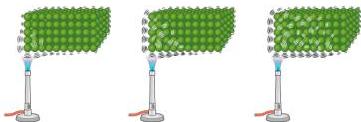
In liquids, energy is similarly transferred, but primarily through collisions between particles as they move past each other.
Thermal Conductors and Insulators
Materials differ in their ability to conduct heat. A good conductor allows heat to transfer relatively quickly. Metals are prime examples of good conductors in both solid and liquid states, with silver, gold, and copper being particularly efficient.
Poor conductors are known as insulators. They allow heat to transfer only slowly. Common insulators include wood, plastics, and gases like air. Materials that trap air, such as fibreglass or foam, are also excellent insulators. It is important to note that conduction cannot occur in a vacuum because there are no particles to pass on kinetic energy.
Conduction in Different States of Matter
The physical state of a substance significantly affects its conductivity:
- Gases are the poorest conductors because their particles are far apart, making collisions infrequent.
- Liquids conduct better than gases but usually worse than solids, as their particles are not held as tightly together as they are in solids, slowing the transfer of kinetic energy.
- Solids are generally the best conductors due to the close proximity of their particles.
The Role of Free Electrons in Metals
Metals are exceptional conductors in both solid and liquid states because they contain free electrons. These electrons are not bound to specific atoms and can move throughout the lattice of metal ions.
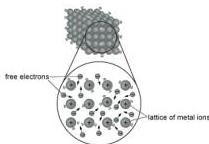
When a metal is heated, both the ions and the free electrons gain kinetic energy. While the ions can only transfer energy slowly to their immediate neighbours, the free electrons move rapidly through the lattice, colliding with other electrons and ions. This allows for a much faster transfer of energy than in non-metals.
Worked Examples: Comparing Conductivities
Example 1: Ordering Substances
Write these substances in order of thermal conductivity, from the best insulator to the best conductor: liquid water, water vapour, solid aluminium, and ice (frozen water).
Solution: Aluminium is a metal and is therefore the best conductor. Ice is a non-metal solid and a poor conductor, but it is better than liquid water. Liquid water is a better conductor than water vapour because particles in a liquid are closer together than in a gas. The order from best insulator to best conductor is: water vapour, liquid water, ice, solid aluminium.
Example 2: Silver vs Rubber
Explain why liquid silver is a better thermal conductor than solid rubber.
Solution: Silver is a metal. It contains free electrons that move through the material in both solid and liquid states, transferring energy rapidly. Rubber is a non-metal with no free electrons, so it conducts heat much more slowly through ion vibration alone.
Factors Affecting the Rate of Conduction
Consider two objects at temperatures and connected by a material with a uniform cross section.
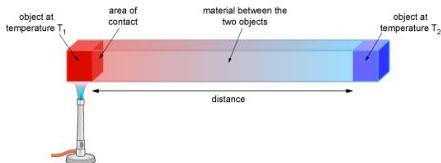
If is greater than , heat flows from left to right. The rate of this heat transfer depends on several variables:
- The temperature difference: A higher difference () results in a higher rate of transfer.
- The nature of the material: Substances that are better thermal conductors transfer heat more quickly.
- The distance: A shorter distance (or thickness) between the two objects increases the rate of transfer.
- The surface area: A larger area of contact between the objects and the connecting material increases the rate of transfer.
Surface Area and the Rate of Heat Loss
When an object is surrounded by a substance at a different temperature, the area of contact is its total surface area. Comparing two objects at the same temperature, the one with the larger surface area will lose or gain heat faster.
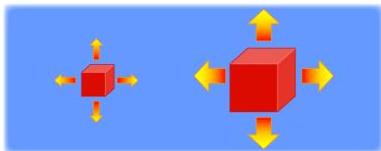
A larger surface area allows for more frequent collisions between the surface particles and the particles of the surrounding medium, leading to a higher rate of energy transfer.
Worked Example: Window Design
For each pair of changes to a double-glazed window, state and explain whether the changes could be made without changing the rate of thermal conduction through the window.
- Increasing the glass thickness and decreasing the window area: No. Both changes decrease the rate of conduction individually, so the combined effect must be a decrease.
- Replacing air with a gas that is a better insulator and increasing the window area: Yes. The better insulator decreases the rate, while the larger area increases it. These effects could cancel each other out.
- Decreasing glass thickness and replacing air with a vacuum: No. Conduction is not possible through a vacuum, so the rate of conduction through the window must drop to zero.
Key takeaways
- Conduction is the transfer of heat through kinetic energy exchange between particles in solids and liquids.
- Metals are superior conductors because they possess free electrons that can rapidly move through the lattice.
- The rate of conduction increases with larger temperature differences, larger surface areas, and better conductivity of materials.
- The rate of conduction decreases as the distance (or thickness) of the material through which heat must travel increases.
- Conduction cannot occur in a vacuum because particles are required for the transfer of kinetic energy.
When answering questions about heat loss in buildings, remember that increasing the thickness of an insulating layer is equivalent to increasing the 'distance' factor in conduction, which always reduces the rate of heat transfer.
Do not confuse thermal energy with temperature. Temperature measures the average kinetic energy of particles, while thermal energy represents the total energy within the substance. An object with a lower temperature can have more thermal energy if it has a much larger mass.
The efficiency of metals in conduction is directly linked to their electrical conductivity; the same free electrons that carry electrical charge also carry thermal energy, which is why most good electrical conductors are also good thermal conductors.
Frequently asked questions
Why are gases typically poor thermal conductors?
Gases are poor conductors because their particles are very far apart compared to their size. This means collisions between particles occur infrequently, making the transfer of kinetic energy very slow.
How does a double-glazed window reduce heat loss by conduction?
A double-glazed window features a layer of trapped air between two glass panes. Since air is a very poor thermal conductor, it significantly slows down the rate at which heat is transferred from the warm interior to the cold exterior.
Is silver a better conductor in the solid or liquid state?
Silver is a good conductor in both states because of its free electrons. However, generally, substances are better conductors in the solid state than the liquid state because particles are held more tightly together, facilitating easier kinetic energy transfer.
Why do some cooking pans have plastic handles?
Plastic is a thermal insulator, meaning it conducts heat very slowly. By using plastic for handles, the rate of heat transfer from the hot metal pan to the user's hand is reduced, making the pan safer to hold.